Sunday, December 11, 2011

Despedir

We departed Namaacha on Thursday, December 8.

When staying with a host family, it is appropriate to give gifts either at the beginning of a visit or at the end.  Dan and I didn’t know what to buy for our family before having met them, so we waited until the end of our homestay to present the gifts we had been collecting throughout training.  On our last day, Dan and I packed three plasticos (literally, plastic bags) with gifts, one each for Mae Atalia, Ajuvencia, and Chovito.

In Mae Atalia’s plastic bag, we put
  • A jar of Nutella (she once provar-ed ours and announced “Animada!”)
  • A sharp kitchen knife (The family was always misplacing their only knife)
  • A blue 50th anniversary Peace Corps shirt (Dan and I have matching ones)
  • 10 Earl Grey tea bags that my family had sent from home (Mom and I had a tea-bag-sharing operation.  And by this I mean, I would make my morning tea and then hand her my used tea bag.  She was also “Animada!” about Earl Grey Tea.)

In Ajuvencia’s plastic bag, we placed
  • A beautiful pink shirt (flexible for a changing belly)
  • Baby rattles (a gift from Dan’s Aunt Wendy in the United States)
  • A music CD

In Chovito’s plastic bag, we placed
  • A bootleg copy of the Lion King 2 with subtitles in Portuguese (we had let him borrow the computer to watch the Lion King and he loved it)
  • Two miniature plastic pets from a vending machine in America
  • A roll of spearmint LifeSavers
  • A pack of playing cards (falta um Queen, which he had lost earlier)

We also gave them a handmade card, a picture of Dan and me on our wedding day, and a CD with pictures from our homestay.  The CD would play the pictures as a slideshow on the television.  We gave the presents over dinner and the reception was HUGE!  Dan put our pictures on the TV, Ajuvencia pulled out the baby toys, and Mom put on her new shirt.  Chovito was just shy and smiley.  He was too timid to play with his new toys in front of us, but we found the cards spread out on the table the following morning. 

Ajuvencia made us a brown-sugar cake and Argentina and Mario came over to say goodbye.  We sat together as a family and watched one of the many Brazilian telenovellas that air on Mozambican basic cable.  As always, Mom sat wedged between us, and, though her language comprehension is low, narrated what she perceived to be happening on the show.  Often, she would get in arguments with Ajuvencia and Chovito that would last far longer than the scene or incident itself.

“I see three helicopters.”

“There are two.”

“I saw three.”

“There are only two.”

“No, there were three.”

“You saw a shadow.”

Meanwhile, the show would continue.  Suddenly, Mom would notice what was going on and would comment in her matter-of-fact way,

“That woman just killed her husband.”

You would think that this would be annoying, but it’s actually adorable.  Because the Brazilian actors speak so quickly, she has no idea what’s going on.  Sometimes her comments are so off-base that it’s hysterical. 

“That woman killed her husband because he had sex with a monkey.”

Sometimes, her comments are simply practical observations of the things that she sees.  For example, we watched a pre-operational transsexual give a tearful monologue (in full drag) from her hospital bed before her ill-fated surgery.  Mom’s comment was:

“That woman is sad.”

We are going to miss her unnecessary, and usually inaccurate, running commentaries.  Honestly, it is comforting to know that there is somebody else who doesn’t understand these Brazilian telenovellas, either.  Plus, we often like her version better.

We awoke on our last day at 5AM.  It was already bright outside.  Our neighbors switched on their sound system as soon as I turned my key in the door.  Mom had boiled water the night before and left it in a thermos in the kitchen.  We did all those things we always did in the morning:  filled an orange bacia with half-cold, half-hot water, shampoo-ed our hair, dunked it in the bath water, dumped the chamberpot in the toilet, chased it with soapy water from our shower, poured tea, cut a loaf of pao, inserted scrambled eggs, and brushed our teeth with a mug of hot water along the side of the house.  This time, though, we were just a little bit sad.

Before long, we were standing at the gate of our compound, a tall, lightweight slab of sheet metal that swung shut and locked with a padlock.  Mom stood with us, in her new Peace Corps shirt.  Ajuvencia and Chovito were still asleep.


 Mom in her new Peace Corps T-shirt


And thus we left Namaacha the way we entered- alongside our host mother, laden with bags, and uncertain about the months ahead.  We were emerging, however, with a certain new set of skills.  We understood the Mozambican education system.  We knew the history of Mozambique.  We understood the culture and people of our new country.  We knew where we were going.  Most importantly, we now spoke Portuguese.  Dan and I had both earned a grade of Intermediate-High on our final Language Proficiency Interview.

Just before we left, our host mother called our Pai, whom we had never met and who was still working in South Africa.

“Aqui,” she said, handing me the phone, “say goodbye.”

“Oh, um,” I said, taking the cell phone.  “Ola, Pai.  Estamos a sair.  Adoramos a Namaacha e adoramos a Mae.  Obrigada e adeus.”  Hello father.  We are leaving.  We love Namaacha and we love Mom.  Thank you and goodbye (Go with God).

Mom was pleased.  She handed the phone to Dan, who said the same thing.  Strangely, I felt like that was the last piece of the puzzle.  I was now ready to leave.

I was feeling feverish as we walked to the chapa, but I chose to ignore it.  Mom had this belief that I was stronger and healthier than Dan (who had had numerous stomach issues) and I was intent on maintaining that image until I left Namaacha.  Luckily, we left exactly when we did.

I broke into a cold sweat on the chapa ride and my skin began to tingle.  My head was hot and heavy and a creaking pain crept into my bones.  I spent the ride to Maputo pouting quickly on Dan’s shoulder, rattling back and forth on the plastic seat of the chapa. 

Technically, this was an important day for all of us.  Today, we would swear in as official Peace Corps Volunteers and begin our service in earnest.  But, as one other volunteer said as we left the ceremony,

“I never really doubted that I was a real Peace Corps Volunteer.”

The swear-in ceremony took place at the Ambassador’s house in the capital. Chairs were placed around a pool in the backyard, facing a central gazebo.  All of the volunteers, 50 in total, were wearing outfits made of matching material.  One person spoke after another, and, to me, it was becoming interminable.  A rash of goose bumps broke out along my arms while drops of sweat rolled down my back.  I wiggled in my chair, inexplicably sore in every muscle.  I knew that I was running a fever.  I stayed long enough to stand with the others, left hand raised, and pledge the oath of service to the United States.  Then, I quickly escaped to the bathroom where I burst into tears.

It’s not a coincidence that I get sick every time I move.  I hate change.  It makes me sad, and it makes me nervous.  Every time I make a life change, stress shuts down my immune system and leaves me vulnerable.  Being sick in Africa is worse than being sick in the States, too, because you can’t tell if you are feeling the common flu or something more dangerous, like malaria.  Why did it have to be today, I wondered.  I had been looking forward to this ceremony.  Now I was in the service bathroom at the Ambassador’s house, squeezing out tears and leaning on the towel rack, considering lying down on the tile floor.

Luckily, two people had seen me leave: the Peace Corps doctor, Izzy Sacramento, and the Ambassador’s husband, Ted.  Izzy sat me down and looked at me firmly.  She felt my forehead.

“Take off that sweater,” she said.  “It’s making you hot.  Now, tell me your symptoms.”

She did a rapid consultation and gave me Grippon, a combination of anti-histamine, Tylenol, Vitamin C, and caffeine.

“Drink this full bottle of water,” she said.  “And give it thirty minutes.”

The Ambassador’s husband came to greet us and offered to let me nap on the couch in the main room of the house.  I think I laughed out loud at the suggestion.

“No, thank you.  I’m not that bad,” I said.

He invited me in to take a seat, and I obliged.  The house was gorgeous; grand and tiled in that stiff way of government mansions.  There was a koi pond in the corner and a running set of French doors that overlooked the festivities below.  Slowly, I sat myself on a prim, sky-blue couch.  People filtered in and out of the house, so I was never lonely, but I did miss the group photo of the new Mozambique 17 volunteers.


Finally, after two glasses of water, two doses of Grippon, and a full-length nap at the post-ceremony hotel, I was no longer hunched over like an old woman and could have a conversation for longer than five minutes.

Later, while staying at the hotel, Dan and I sat down to talk with the volunteers we will be replacing.  Janet and Lucas have lived in Zobwe for two years.  We are lucky that they have been exemplary and dedicated volunteers.  They had an English theater group, a REDES (girls’ service) group, and a JUNTOS (after-school) group.  They spoke the local language and were fairly fluent in Portuguese upon arrival at site.  The four of us talked for about three hours, ironing out details and logistics.  Finally, we parted ways with a hug.  It was hard not to feel intimidated, but I think Dan and I will do a good job at our new site.  We are feeling optimistic and excited. The school director is thrilled to be getting another married couple.


Janet, Lucas, Lisa, and Dan


After the swear-in ceremony, we took a flight on a small domestic aircraft, complete with propellers, to Chimoio, the capital of Manica.  Once in Chimoio, we began a two-day conference with our future supervisors, covering topics such as Peace Corps policies, volunteer projects, and supervisor duties.  Perhaps the conference itself was not thrilling, but it was wonderful to meet our new supervisor (in our case, the financial director of the school) and to spend a few last days with the vestiges of our once-mighty cohort of volunteers. 

Tomorrow we drive from Chimoio to Tete City (6 hours) and then from Tete City to Zobwe (2 hours).  We will be traveling on a rented chapa with our two suitcases, three cardboard boxes, two black lockboxes, two book bags, standing fan, stainless steel electric teakettle, extension cord, and two chocolate bars (the latter few objects were purchased here in the regional capital).  Tonight, we make our final round of despedirs before beginning a life-changing round of introductions. 

P.S.  Tomorrow’s temperature in Zobwe, Tete?

105 °

Friday, December 9, 2011

A Minha Mae

My host family has been an absolutely integral part of my training experience.  For ten weeks, Dan and I have lived with them, eaten with them, and struggled through conversations with them in our ever-improving Portuguese.  And now, when it finally seems that everything is coming together-the baby has almost arrived, Dan and I can finally communicate in Portuguese- we are packing our bags and moving one-thousand miles away.   

It seems like we are always moving.  First, we left some very good friends in State College to live in Santa Cruz for the summer.  Then, we left our new friends in Santa Cruz to move to Mozambique.  Now, after getting close to this particular family in Namaacha, we are moving to another province, this time in the far northwest of the country.  Honestly, it’s been very painful.  This time, however, it will be a little more painful.  Before, we were leaving friends.  This time, we are leaving a surrogate family.


Dan with Ajuvencia and Chovito at the Host Family Celebration


When we stepped off the bus in Namaacha, dragging our backpacks and plasticos and rain boots, we didn’t speak a word of Portuguese.  We were overwhelmed in a new country.  Everything was new.  Most of us were sick.   Some of us were already homesick.  When we met our host mothers, we were like baby chickens hatching from an egg.  We imprinted on our host mothers immediately.   

On my first day, I couldn’t say much more than “me,” “want,” and “no!”   I had learned the phrase “posso ajudar?” (can I help?) from my handbook, but couldn’t understand mom’s answer whenever I was brave enough to ask.  Somehow, though, we developed a working relationship.  I would try to help whenever I could, and when I couldn’t, I would sit with her in the kitchen.  I would tell her where I was going and when I would be back.  Perhaps most importantly, I always made sure to find her and say “goodnight.” 

In the end, she adopted our friend Adrienne, too.  Adrienne’s own host mother was apathetic to the young volunteer living in her household.  By the end of training, Adrienne was buying breakfast and lunch in town and making her own dinners alone in the kitchen.  Adrienne’s host mother chose not to attend the Host Family Celebration and left Adrienne to pick up her certificate and pose for pictures sozinha (alone). 


Adrienne poses alone with her Family Certificate


When my host mother discovered that Adrienne’s mom was not exactly behaving like a loving, protective parent, she took over immediately.  She served Adrienne dinner for three days straight and even packed her a lunch on our last day of school.  When we took family pictures in our last week, our host mother insisted that Adrienne be in all of them. 


Adrienne, Lisa, Mae Atalia, and Dan

Because my host mother is an amazing and delightful woman, I wanted to record all that I could about her before leaving Namaacha.  Furthermore, I wanted to share her with all of you.  In the spirit of the third Peace Corps goal (teaching other Americans about the people and culture of Mozambique), I give you my host mother, Mae Atalia. 


Candid photo of Mae Atalia in front of her barraca, taken in October

For this segment, I asked my host mother to pose for several portraits and to sit for an interview.  Before we begin, I have a few notes about each of these things.  First, my host mother chose her best outfits for her portraits.  These are church outfits, and most are so precious that I never saw them before these photographs were taken.  In general, Mae Atalia wears a simple cotton dress with an apron or a T-shirt and capulana wrap.  Usually, she wears her hair up, but in most of these pictures, it is curled and oiled for picture day.  Second, this was mom’s first interview, ever.  I have translated it into English.  Some answers might seem simple, but they are honest and reflect the scope of her life and desires.  In other words, Mae Atalia has not been given many choices or many opportunities.  In asking some broad questions, her answers might not seem very creative or ambitious.  This is because she is aware of the limitations that bind her life and choses to answer within these boundaries.  She is a very pragmatic individual.


Mae in her Sunday best


Where were you born?
          I was born in Massinga, Inhambane province, on January 1, 1965.

How long did you live in Massinga?
          Until I was 25 years old.

What grade did you reach in school?  Did you like school?
          I went to school until third grade.  I liked school very much, but my parents died when I was little so I ran out of money to pay school fees. 

When did you get married?
            I started dating your father when I was 27, in 1992.  We stayed together for many years but didn’t get married until 6 years ago, when his company in South Africa asked for a marriage certificate. 

What are your hobbies?
            I like to go to church.  I like to sing in church and I like to dance in church, too.

What is your favorite food?
            Xima (watery ground corn), chicken, and vegetables

If you had one billion Meticais, what would you do?
            I would go to Maputo and buy more things, then come back to Namaacha and sell these things.

You can’t use this money to make more money!  What would you do if you won money as a prize?
            I would use it as capital

No.  You can’t do that.  Spend it on something that is just for fun.  What have you always wanted to buy?
            I would give it away to the people in this neighborhood who have no money

And if you had to spend it on yourself?
            I would build a sidewalk from the barraca to the house so that we would not be muddy when it rains.


 Mae in her Sunday Best


What is your most prized possession?
            I don’t understand.

What thing in this house is most important to you?
            Everything in this house is important and special to me.

If there was a fire inside this house, what is the first thing that you would save?
            My bed and blanket.

Where would you like to visit one day?
             South Africa

Where have you already visited in the past?
            South Africa

Finally, what do you want for your future?
            I want to live with my husband for the rest of my life.


Mae in her Sunday Best

            *          *          *          *          *          *          *          *          *          *          *

By the time we return, Ajuvencia will have had her baby.  Our Pai will have returned home for his one-month’s leave and then will have left again.  Chovito, our cousin, will be gone, living once again with his parents in Massinga.  Hopefully, though, Mae Atalia will still be there, singing in her mother tongue while shelling peanuts in the barraca.  Maybe, if the temperature is anything less than balmy, she will be wearing her funny red woolen cap.  And maybe, if we're lucky, she has been missing us as much as we have been missing her.  


Dan and Chovito playing in the rain at the Host Family Celebration


Dan and Lisa together at the Host Family Celebration


Chovito dons his Sunday best and asks permission to be photographed

Wednesday, November 30, 2011

Scavenger Hunt

So our fifty-one person training group is adorably, sickeningly, close and cuddly.  Though we are all excited to get to site, we are all a little sad that we will never all, every single last one of us, be together in the same place again.  Entao, in celebration of our last week together, two of our members organized a little game. 

It started with an idea, about a month ago.  Then came a list of materials.  Finally, it all came together this Sunday, with about thirty volunteers, ten lists, fifteen cameras, and the entire town of Namaacha.  It was….
The GIANT,
TOWNWIDE,
ALL-INCLUSIVE, Crazy,
MOZAMBICAN
SCAVENGER HUNT!!!

We met at the bar at two PM.  Each team was given a list of materials and a two-hour time limit.  It was that simple. 

“Once you get your list, you can go!” Said Jill.  She was one of the two people who had organized this soon-to-be town-wide spectacle.

“Be back at four!” Yelled Mac.  He was the other one. 

Our team was organized and ready to go.  We had each chugged a Coca-Cola and practiced our game faces.  We were clearly at the top of our game and ready to conquer. 

The team roster is as follows.

This is Lona.  She has no sense of humor when it comes to large-scale group games.


This is Steph N.  She knows karate and can do a push-up from a handstand position.


This is Lisa.  She can cross-stitch a mean bunny rabbit.


This is Steph H.  She… well… she is trying not to smile.


This is Dan.  He is The Man.


We clustered together to read our list of items.

“Are we ready?”  Asked Lona.

“It begins!”  Said Dan.


Things to Procure
Half a coconut shell (clean)
Hair from a weave
A royal flush
A feather
Banana frond
Piece of chalk
Orange peel (whole)
Pack of Maria’s crackers
Laurentina bottle cap

Photographs to take
All team members in the back of a pick-up truck
One team member riding a goat
A mother and baby goat
Team members forming a pyramid with a Mozambican on top
Three team members in a tree
All team members on top of the abandoned building across from the bank
Mozambican wearing sportswear from a U.S. university
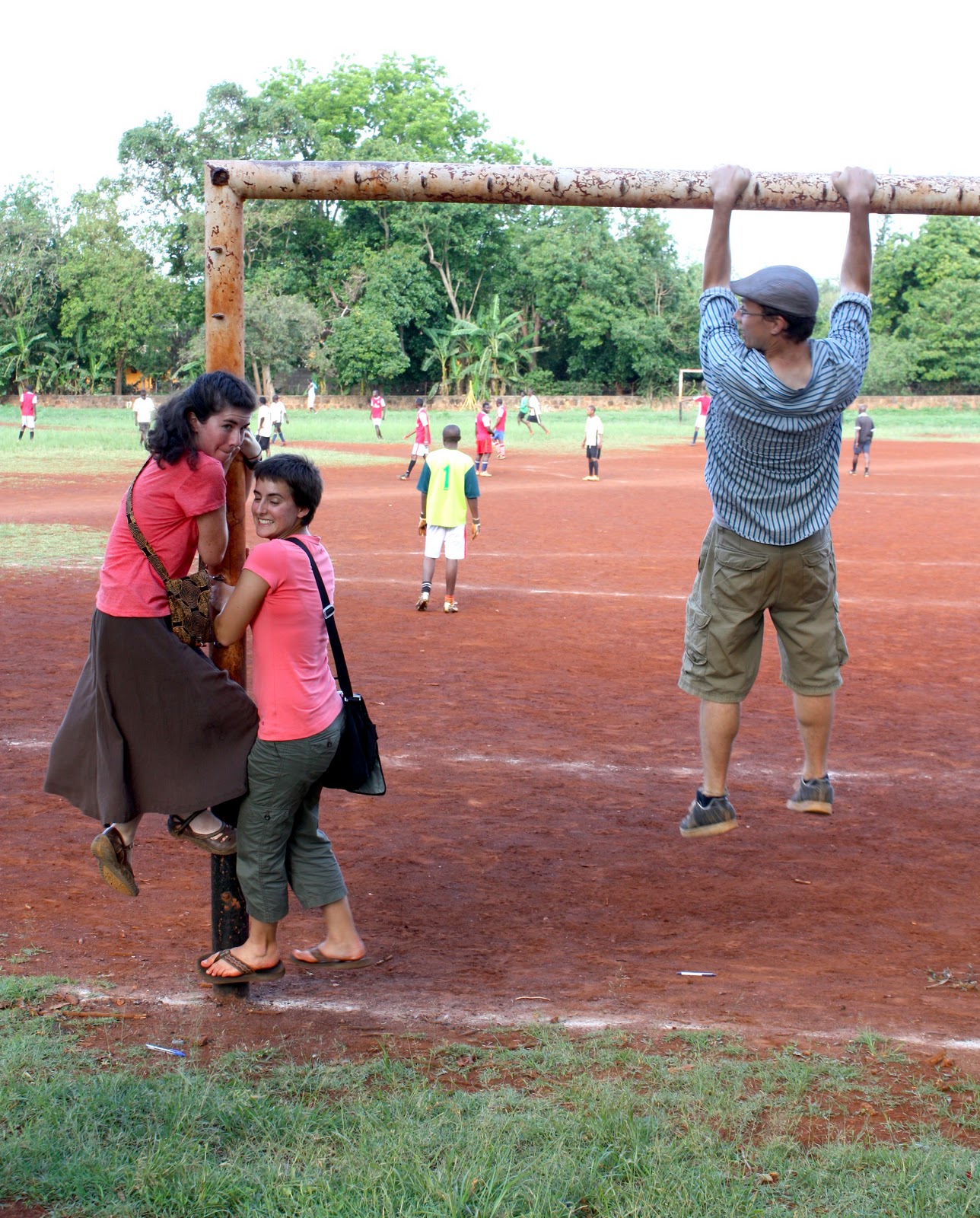
Three team members hanging from a goal post
One team member playing pool
Two team members with the owner of the Internet Café
Three team members in the same lab coat
All team members under the same mosquito net
All team members in capulanas

And now, for your enjoyment, and because I don’t post enough photographs anyway, I give you the Giant, Townwide, All-Inclusive, Crazy, Mozambican Scavenger Hunt. 

A human pyramid capped with a Mozambican child


A Mozambican in Virginia Tech sportswear


Dan riding a Goat in Bairro B


Mother and Baby Goat


Lona, Steph, and Dan hanging from the goalpost on the soccer field.  During a soccer game. 


Dan, Steph, and Steph in the same lab coat


The whole team in capulanas


So that’s about it for photographs.  Those are the best ones, anyway.  There is a montage that shows “the whole team drinking from the world’s worst bottle of brandy while making faces of extreme displeasure,” but those are for another time.  

We didn't actually win the scavenger hunt.  We never made it to the border to take a picture with a border guard or track down a policeman with an AK-47.  We didn't even manage to flag down a chapa and take a picture of the entire team inside.  We did, however, make a lot of friends along the way as we took photos, shared them, and explained ourselves.  We ran all over town, climbed trees, chased goats, and taught my host sister to use a camera.  Finally, we made a really, really nice memory with each other, and that was probably the best part of all. 

The End.

Sunday, November 27, 2011

Dear Diary

Perhaps some people wonder what my day-to-day life is like here in Mozambique.  Perhaps some little volunteer-hopeful is seeking out blogs and information, just like I did once upon a time (three months ago).  Perhaps someone, right now, is saying, “Yes, yes, this information is all very nice, but what is it REALLY like to be a Peace Corps Trainee?” 

Well, my hypothetical reader, this is a fortuitous day.  Today, I will give you a true account of an entire day in the life of an American girl in Mozambique.  If I kept a diary, this would be my entry for November 26, 2011. 

Dear Diary,

I started my Saturday at nine AM.  My host cousin Chovito was sitting on the front porch of the main house.  He giggled when I opened my front door. 

“You sleep a lot,” he said, from his perch. 

“YOU sleep a lot,” I said. 

“Nao e a verdade,” he said.  The equivalent of nuh-uhhh.

Chovito is a relatively new person in our household.  He is ten years old and small for his age.  Since he moved in unceremoniously and unannounced three weeks ago, we have learned to keep a careful eye on our belongings.  Chovito is basically a baby raccoon.  He is super cute, but very, very curious.  Like a raccoon, he enjoys playing with garbage and is usually a bit scruffy.

Chovito wiggled around to better face me.  “T-t-t-t-toma banho?”  Take a bath?  Our host cousin also has a stutter, which our host mother actually felt the need to point out to us upon his arrival. 

“No,” I said.  “We aren’t going to take a bath.  We took a bath last night.  We are going to clean our house.”

“Shato!” said the boy.  Directly translated, shato means “boring.”  It also means “darn,” or “crappy,” or “golly” or “booooo!”  Basically, it’s a catch-all swear word for kids.  Shat-ooooo!

Dan and I were cleaning in preparation for our big move.  We leave our training village in one-and-a-half weeks.  Peace Corps wants us to pack most of our belongings now, because they will be shipped to our sites prior to our arrival.  Entao, we are taping boxes and stuffing them with everything in sight- pillows, blankets, extra clothes, books, etc. 

“Really?” we had asked our trainer when we read over our packing list. “The pillows?”

“The pillows,” he confirmed.

Shato!

The first two hours of the morning were spent sifting through endless papers, folding sheets, and finding hidden garbage.  We cautiously fished out objects from underneath our bed, remembering the story of one volunteer’s host sister who had found a scorpion in her dirty room.  We found no scorpions, but did find that Dan’s sneakers had been sewn shut with spider webs. 

“Ew,” I said, swabbing out sticky strands with my finger.  “Why?”

“I only wear my sandals,” said Dan.  “Look at this tan!”  He gestured to the white lines on his feet.  It’s true that we have all generated very unique tans.  In the words of another volunteer, “It looks like we’re wearing clothes even when we’re not.

I was in the process of shaking ants out of my rain boots, when my sister yelled, “Mana Lisa!” 

Here in Mozambique, they yell exactly as I was instructed not to when I was a teenager.  Want to get the attention of somebody in the next room or across the compound?  Why would you search for them if you could just let out a soul-jarring squaaack!

“Ooooo que?”  I asked.  Whaaaat?

“Make your breakfast,” she said. 

I had been planning on skipping breakfast, since the night before had been our All-Volunteer-Thanksgiving-Potluck.  Suddenly, though, breakfast seemed like a reasonable idea. 

“Fine,” I said. 

“Make eggs,” she said.

“Fine.”

“The pan is here.”

“Fine.”

“Make them now.”

Sigh.

Dan drank a warm beer from the night before while I fazer-ed some eggs.  Our host family gets a kick out of watching us fulfill our traditional gender roles.  To be honest, we enjoy it just as much. 

“That’s right, cook those eggs.” Said Dan. 

“You just sit there and drink your beer,” I said.  “I don’t want you to get hurt.  I’m pulling some pretty crazy stunts over here.” 

“Just make me my eggs, woman!”

I added in a few pieces of Parmalat Plastic Cheese to make our Saturday morning breakfast extra-special.
 
Mata-biche is always nice at our host mother’s house.  In general, we set aside a full twenty minutes to sit quietly and drink tea.  On weekends, we might even stay for a full hour, conversing in English and switching to Portuguese when somebody else enters the room. 

I stuck my hand over the thermos of hot water on the table to make sure that the water had been boiled and not just heated up.  Though boiled, unfiltered water in Mozambique is saturated with dead bacteria, it tastes just fine with a stout bag of tea and a tablespoon of sugar.  As long as the steam coming out of the thermos scalds my hand to the point where I screech and jump backwards, I consider the water safe to drink.  I do this every day without fail. 

So with our thick, green cups of tea and plastic scrambled eggs, we settled in for a long and comfortable breakfast. 

“You know, we haven’t had sex for a while,” said Dan.

“Daniel Adam!”

“What? I’m just saying.”

“That word is the same in English and Portuguese.  Chovito is right there!

“I’m just saying.”

“Hmph.”

In an effort to be honest, though, being in the Peace Corps is not the sexiest experience.  You might try hard to maintain some semblance of privacy, but that is impossible when both individuals claw their way out of the mosquito net and race to the bathroom at the same time.  When this happens, one individual is forced to pace outside, walking pigeon-toed and saying, “you don’t have to get it all out!  Just enough so that you won’t poop yourself.  It’s my turn, now!”

After breakfast, I took a load of dishes to the washing station in front of the house.  If there is anything I hate at my host mother’s house, it is the dishwashing station.  They employ the two-bucket method, yes, but they leave the dirty water in the bacias and reuse it for the entire day.  This includes four meals: breakfast, little lunch, real lunch, and dinner.  I end up washing my dinner plate in cheese water that smells like eggs and chamomile. 

I gave the dishes a preliminary rinse in the dirty water, then levantar-ed some clean water from a barrel in the kitchen.   I like to think I have gotten clever with my dishwashing technique.  I put some soap and water in a mug, clean that, then pour the soapy liquid into the next mug.  When it comes time to rinse, I give all of the dishes a quick splash to remove the suds before lowering them into the clean water.  That way, I still have almost all of the water that I started with AND it’s still clean, to boot.  Whenever my host mother sees me doing this, she shouts out, “Nao, nao, nao!”  I have come to dread doing chores in her presence.  Luckily, today was Shoprite day.  Mom would be selling sugar, salt, and grain outside the market fence until it got dark.  Chovito was put in charge of the barraca.  Ajuvencia was in charge of us. 
 
We cleaned our house from breakfast until lunch.  Most of our energy was spent  trying to decide which things we would need over the next two weeks, which things we wouldn’t need, and which things we would never need.  Colored Pencils?  Won’t need those until we get to site.  Malaria medication?  Need that.  A broken watch bought at Shoprite on our first day?  Do not need that.

Adrienne and Lona came over for lunch in the afternoon.  The plan was to rehydrate some homemade rice pudding with cream and eat the stuffing and mashed potatoes that we had brought home from the Thanksgiving party.  Unfortunately, the power had cut out a few hours before, so it would not be easy to cook.  We would have to share the charcoal stove with our sister.  Through pure laziness and unwillingness to cook over the carvao, we decided to serve the stuffing and mashed potatoes cold.
 
The Thanksgiving party the night before had been a big, big deal.  Every person was ordered to bring enough food to feed ten other people.  In total, we served two turkeys, four chickens, two gallons of stuffing, four gallons of mashed potatoes, three gallons of gravy, two bowls of green bean casserole, fifty sweet potatoes, fifty rolls, cornbread pancakes, rice pudding, cinnamon chips, apple pie, apple crisp, mango pie, and brownies.  Adrienne had brought an extra tijela, so we filled that with food at the end of the night, after the party.  Unfortunately, we had no way to keep it cold.  For lack of a better option, Dan and I decided to leave it on our floor until morning

(Dear hypothetical volunteer-hopeful:  You’ll be surprised how quickly you will let go of American standards for food preparation.  Here is an example.  When Dan and I returned home from the party, he lost his grip on the pot that held my precious cinnamon rice pudding.  Without warning, the panela crashed to the ground, deposited the pudding upside-down, and then bounced away.  Amazingly, the pudding had molded to the shape of the panela and was sitting there firmly, like the turret of a sand castle.  I promptly grabbed the top half of the rice pudding and plopped it back into the pot.  The other half I scraped up and chucked into the lixo pile.  Then, I stored the pudding remains along with the other food on the cement floor of our house.  The next day, Lona, Adrienne, Dan, and I shared a fork to eat these same lukewarm leftovers from the same giant tijela.  Happily -and this is the moral of the story- we all survived this questionably-hygienic experience.)

It was just about lunchtime when Chovito came up to me with something in his hand. 

“P-p-p-posso ter isto?”  Can I have this?  He was holding our old broken watch in his hand. 

“Is that… lixo?”  I suddenly felt guilty.  Why did I throw that watch away without first offering it to Chovito?  I should have known better.  “Yes.  Keep it.  It’s yours.”

I looked past him and was startled to see that he had sifted through all of our garbage.  A pile of hand-outs had been turned into paper airplanes. 

“Chovito, you can have anything from the garbage, okay?”

“Okay.”  He grinned, then held up his wrist.  “Meu reloj.”  My watch.

I watched as he proceeded to take all of our plastic bottles out of the trash and form them into a little pile.  He sang to himself while organizing all of his new toys.  

Chovito’s enthusiasm for garbage is surprisingly endearing.  But he has one trait that is even more charming- my host cousin loves to do needlepoint.  He saw me making a needlepoint chicken one day and sat down to watch.  Aware that this wasn’t the most thrilling of activities, I offered to teach him how to make “passarinhos,” or little birds, of his own.  Thus far, he has only stitched a few jerky letters on his embroidery cloth, but he likes to sit out on the front porch with all of the thread and tie knots like a little tailor. 


Chovito sews on the front step


Ajuvencia is also learning needlepoint.  I tried to teach her how to make “X-inhos” (sheesh-een-yo-sh:  a made-up word that means little x’s), but she didn’t have the patience.  Instead, she asked for some thread and then disappeared.  The next day, she returned with this:


I love you, Mana Lisa


In Mozambique, it seems, spelling is not as important as the actual sound of the words when they are quickly strung together.  With or without spelling mistakes, it was a touching gift.  Ajuvencia has already started saying that we are not allowed to leave in December.  It’s heart-wrenching to hear, especially when the speaker is eight months pregnant. 

Lona went home after lunch and was quickly replaced by another volunteer, Stephanie.  (Houses in Mozambique are like very busy train stations).  Dan and I are awfully fond of Steph.  She is little and cute, with short-cropped hair, a quiet voice, and a quick wit.  We like to say that she has a great big personality funneled into a little tiny voice.  When she talks, we all lean forward to listen.  She had come over to play cards.  Just before I dealt the first hand, however, we were interrupted by a knock on the door.   It was Mario, our host cousin.

“Come in, Mario,” I called.  “I can make introductions.”

“Okay,” he said.  “Hello.”  Mario is twenty-five years old, sort of cute, and very awkward.  He is not good at translating my creative Portuguese into real Portuguese, so he often gives me a funny face when I am saying something unusual. 

“Mario, this is Stephania and Adrianna.  They are my friends.  Stephania and Adrianna, this is Mario.  He is our cousin.”

“Muito prazer.”

“Muito prazer.”

“Mario, would you like to play cards?”  To my surprise, Mario’s eyes lit up. 

“Sure!”

“Okay,” I said, shuffling the cards slowly.  “We can play… vai a buscar as peixes.  Do you know that game?”

Adrienne and Stephanie laughed.  Vai a buscar as peixes means “You go to look for the fish.”  The actual name of the game, “Go Fish,” is harder to translate. 

Mario did not know how to play Go Fish, but he caught on quickly.  It turned out to be a pleasant afternoon.  Dan sat on the floor, sewing a broken sandal.  Chovito was on the front step with his needlework.  Adrienne, Steph, Mario, and I were practicing our Portuguese in the living room over a rousing game of You Go to Look for the Fish. 

By dinnertime, all of our guests were gone.  In Mozambique, few visitors stay after six or seven in the evening.  Dinner, or jantar, is a time for family.

“Have you ever tried this plate before?” asked my sister, putting a dish down in front of me.

“I have no idea,” I said.  “Vegetables all look the same to me.”  In the shallow bowl, there was some sort of leafy green floating in a coconut sauce. 

“Try it,” said Ajuvencia. 

“Okay,” I said.  I shoveled a few spoonfuls onto my rice.  “I will probably love it.”  In my host family, I am known for hating meat and loving vegetables. 

“Try it,” said Ajuvencia.

I filled a spoon with rice and sauce and shoved it into my mouth.  Then, alarmed, my eyes went wide and my tongue stuck to the top of my mouth. 

“Oh, my God.  O que e, o que… blehhhhh.” 

Ajuvencia and Chovito burst into laughter.

“Is this food?”  I asked. 

“Yes!”  Said Ajuvencia.  “It’s food!”

“This is NOT food.  Do YOU like this food?”

“Yes!”

“Lies.”

“It's good!”  Said Ajuvencia.  She and Chovito were rolling on the floor, laughing.  I gave the food a sniff.  The coconut smell that wafted from the sauce belied the bitter, sour-pungent taste of leaves within. 

“Wow.”  I said.  “Dan, how do you like it?”

He shrugged, unmoved.  “It’s fine.”  Liar.

Ajuvencia and Chovito laughed, kicking their legs up and down.  “Not everybody likes it,” admitted Ajuvencia. 

“But do you like it?”  I asked.  “For real?”

“Yes,” she said. 

“Ughhh.  Lies.  Well, then, I like it too.  I like it so much that I will eat all of it.”  I dipped the spoon in and took another giant gulp.  This time, I didn’t chew.  I forced a smile.  “Mmmmmmm.”

“Nao!” said Ajuvencia.  “I can throw it away.  I made other food.” 

Just then, Mom returned home. 

Chovito was unable to contain himself.  “Mana Lisa n-n-n-nao gosta a cacana!” He giggled gleefully.  “Nao gosta!”  Lisa doesn’t like the cacana!  She doesn’t like it!

I was worried that our host mother would be insulted, but she just laughed.  “Americans don’t like cacana,” she said.  And so I ate my usual vegetable mixture, which Ajuvencia had prepared in preparation for my reaction. 

Looking around at my host family- Ajuvencia, Mae Atalia, and Chovito- I felt sad that I would have to leave so soon.  Half of my things were already packed away in boxes.  Soon, the little cinderblock house would sit empty.  Perhaps Ajuvencia would move in once she had the baby. 

It will be so hard to stay in contact once I leave.  Mae and Ajuvencia have telephones, but my Portuguese isn’t very good.  Mae can’t read and doesn’t have a home address, so sending a letter is out of the question.  Sadly, Ajuvencia will have the baby just a week or two after we leave.  I’m not exactly excited that this sixteen-year-old is giving birth, but I would like to meet the baby.  The mother has a special place in my heart, after all.  We told her to name the baby Dan, if it’s a boy, or Lisa, if it’s a girl.  Who know?  Maybe she will. 

I looked a map the other day to try and understand how far away we will be moving.  The answer is, sadly and surprisingly far.  From north to south, Mozambique is about as tall as the United States.  The coastline of Mozambique is twice the coastline of California.  From Maputo, the capital, to Zobwe, Tete, we will be traveling 1,660 kilometers, or just over a thousand miles.  This is the distance from San Diego, California to Portland, Oregon.  It is also the distance from State College, Pennsylvania to Orlando, Florida.  So the chances of us coming back to visit anytime soon are very, very slim.  By the time we return, the baby will be at least one year old.  Shato!


The United States and Mozambique, side by side


If you can judge your success in a place by how sad you are to leave it, then I would say that Dan and I have had a very successful homestay in here Namaacha. 

Love,   
Lisa Jo


So there you have it, my hypothetical volunteer-hopeful.  A real day in the life of a volunteer trainee.  Most days you will have language lessons and tech sessions, but some days will be open, and those are the most fun.  My suggestion to you is this- build a good relationship with your host family.  Play cards, show them your sewing, watch a movie with them, talk to them, whatever.  Even if you don’t speak the language yet, you can go outside and watch your little brother throw around a paper airplane.  Remember that this is why you are here.  You signed up to be a Peace Corps Volunteer because you wanted to make friends and change lives.  Just sit and watch that boy throw the paper airplane for a little while.  I promise that it will be rewarding.  I promise. 


Chovito and his Needlepoint


Friday, November 18, 2011

Site Announcements

Fifty-one volunteers-in-training stood around the edge of the basketball court, looking over an ultra-large chalk map of Mozambique.  Each of the eleven provinces were outlined in a different color and labeled in bubble letters.


We all held in our hands a full-sized envelope with a letter stapled to the front.  The letter read,

“Dear Moz 17 Trainees,

Congratulations on your assignments.  We hope that you are as happy as we are about where you'll be spending the next two years of your life.  But even if you are not absolutely ecstatic at this moment- even if you are completely nervous about the great unknown ahead of you- let us share something to help you keep some perspective and manage your expectations a bit

Life is calling.  How far will you go?

Though many of you took the “opportunity” to tell us what you wanted in a site, “important” things like mountains, cell phone coverage, people you'd like to be near, etc, please know that our first priority in deciding where to send you was finding a job that matched you (and vice versa).  So if you happened to get some of these “amenities,” good for you, but that's not why we placed you there.  And if by chance, you didn't get something that you really thought you couldn't live without, just know that you will live with out it.  AND YOU WILL BE FINE.  This is the Peace Corps...in Africa...in one of the poorest countries in the world.  If you go back to your recruitment materials for Mozambique, what you agreed to before you ever stepped foot in Mozambique was potentially a life with latrines, without electricity and running water, and yes, even without cell phone coverage or Internet. So in essence, if you are disappointed, we encourage you to refocus your energies on what really matters- why you are here and what you want to get out of this experience.”

We read the letter silently, in unison, and then looked up.  Our Associate Country Director stood in the center of the basketball court. 

“I will count down from ten,” he said.  “And then you can open your letters.  Ten..........”

He waited too long. The countdown was instantly out of his hands as we yelled, “Nine!  Eight!  Seven! Six! Five! Four! Three!”

“Two!”

“One!”

There was a flurry of motion as fifty-one volunteers tore at the secure white flap of their envelopes.  I shook out the contents of my folder and grabbed hold of a full-page map of central Mozambique.  Our future site was highlighted in yellow. 


Central Mozambique

Dan and I looked at each other with a slow, creeping smile.  Then, I threw my arms around his neck. 

“Tete!  Tete!  We're going to Tete!”

He kissed me on the cheek.  “Are you excited?”

“I don't know!”

“Should we get on the map?”

We happy-danced over to the northern thumb of Mozambique.  People were streaming around us, looking equally overwhelmed and excited.  Everyone was looking for their sites first, and then their friends. 

“Oh, my God,” I said.  “We're the only ones in Tete!”

We were standing alone in the very northern thumb of this giant country. 

“It's okay,” said Dan.  “It's great!  People will come visit us.  And there are already seven volunteers in Tete!”

I pulled the rest of the contents from the envelope.  “Let's read the site description.”  The previous volunteers, a married couple named Janet and Lucas, had filled out a form for us with basic information about our future location.

“Site Name:  Zobwe, Tete (Pronounced Zob-way, Tett)
Name of School:  Escola Secundaria de Zobwe
Dan's Job Description:  10th Grade Math Teacher
Lisa's Job Description:  10th Grade English Teacher

House Description:  1 small bedroom, 1 tiny room, 1 closet, 1 kitchen, 1 living room.  Latrine in yard, is almost full.  Outdoor shower room attached to latrine.  Refrigerator.  Toaster Oven.  Blender.  Electric 2-Burner Stove. 

Favorite Things about Site:  Great weather (in the mountains, not too hot), good daily market, easy transport, beautiful scenery for hikes, nice medium-sized town with tight-community feel, easy immersion in dense neighborhood, fun to be on Malawi border, safe.  We love Zobwe!”

“Are you happy?”  Asked Dan hopefully.

“So happy,” I said.  “I think it's perfect.” 

We looked around the basketball court.  Our friends were scattered, but not impossibly distant.  Nobody was crying.  Slowly, people started to move away from their sites and visit their new neighbors and friends.  Adrienne and Lona came to visit us.

“You’re so far,” they said, but somehow, none of us were sad.  We had all gotten what we wanted.  Adrienne was in Sofala, near Beira.  She would be teaching English.  To get from her town to the capitol, she would have to take a boat.  Lona would be living near the “L” in Nampula, teaching math.  Her house would have no electricity and no nearby source of water. 

“We’ll see each other,” we promised.  “We’ll meet up for Christmas!”  We had no way of knowing if that was true or even possible, but when we said it, we meant it sincerely.

Everybody was hugging everybody else.  It was apparent right then, in that particular moment, that this was a genuinely kind group of people.  From all around us we heard positive statements.

“Where are you?  Are you happy?  I’m so glad.  You are going to do an amazing job!”

Multiple people came up to chalk-Tete and hugged Dan and me.

“You guys have the best site.  You are so lucky.  I am coming to visit you!”

It’s still surreal to us, that we are going to Tete.  It is uncharted territory.  On my original map of Mozambique, we will be going where I had written “crocodiles,” not far from “mystery” and “mountains.”  We will be far north of the Tropic of Cancer.  And we will be there for two years. 

Life is calling.  How far will you go?

The answer, my friends, is muito, muito la.


P.S.  Would you like to hear a crazy story?

In 2007, two friends from Loyola College in Baltimore decided to apply for the Peace Corps during their senior year.  They wrote each other’s reference statements and even interviewed on the same day.  Alyssa was nominated to serve in Vanuato, an island in the South Pacific.  Angie was nominated to serve in Mozambique.  Both girls departed in September 2007. 

They kept in touch throughout their Peace Corps service.  Angie joked that she sent the world’s first letter directly from Mozambique to Vanuato.  The girls completed their service in November 2009 and returned to the United States, where Alyssa took a seasonal job at Shaver’s Creek Environmental Center.  She was working at Shaver’s Creek when she met me.  It was largely her description of the Peace Corps and of her experiences (good and bad) that inspired me to apply with my husband in March of 2010.  Eighteen months later, Dan and I departed from the United States in September of 2011. We received our site announcements in November of 2011. 

Here is the crazy part.  We are replacing Janet and Lucas, a married couple in Zobwe, Tete.  In November 2009, Janet and Lucas replaced a girl named Angelina, nicknamed Angie. Angie attended Loyola College in Baltimore and applied to the Peace Corps in early 2007 with her good friend, Alyssa Thiel.  It is her site to which we are headed. 

Of all the people in our life, Alyssa has been incredibly pivotal.  If she wasn’t there to tell me her giardia story or eating-yellow-paint story or even the dead-cat story, I probably never would have worked up the courage to take that first step in my Peace Corps application.  And now, after a year and a half of medical paperwork, interviews, and language lessons, we are taking over her friend’s site in Tete.  Of all places on this giant earth.
Zobwe, Tete!