Thursday, December 20, 2012

South Africa: Cape Town to Kruger

It's been hard to readjust to Mozambique after spending nearly three weeks of travel South Africa.  From the moment we arrived in Cape Town, we were surrounded by luxury- hot showers, clean linen, restaurants, grocery stores, and our own personal vehicle (a Hyundai with a manual transmission and a stick shift on the left).  South Africa, it seems, is a world apart from its southern African neighbors. 

Our trip lasted 19 days and spanned the length of the country, from east to west.  From the beaches and mountains of breezy Cape Town, to the vast, scrubby wilderness of Kruger National Park, we drove more than 2,500 miles, took more than 1,500 photos, and sampled only a handful of destinations in this diverse and sprawling country.  What follows is a sampling of our sample- a glimpse into bountiful, beautiful, charming South Africa.

Our traveling companions:  Fellow PCV volunteer Jamie Randol and her boyfriend, Drew
Flying South African Airways (free beer and wine included)
Flying over South Africa
New currency:  2 South African Rand (worth about one US quarter)


Cape Town, Western Cape
First stop:  Cape Town
Cape Town

Founded in 1652 by the Dutch East India Trading Company, Cape Town was first used as a base to provide supplies for Dutch ships traveling to Eastern Africa, India, and the Far East.  Nowadays, it is the second most populous city in South Africa and the leading tourist destination in the country.  The city is famous for its good climate, natural setting, well-developed infrastructure.  The bulk of the city (known as the City Bowl) sits beneath the massive backdrop of Table Mountain, which is protected by Table Mountain National Park.  To the south lies Cape Point, the headland of the dramatic Cape peninsula.  Both areas lie within the Cape Floral Kingdom, which is home to more than 9,000 species of vascular plants and is regarded as a biodiversity hotspot.


Fun Fact

There are more indigenous plant species on Table Mountain than in the whole of the British Isles.


Favorites

Climbing Table Mountain (and returning via cable car)

Exploring the shops, restaurants, and views of the Victorian & Alfred Waterfront

Hiking along the Cape Peninsula to visit Cape Point and the Cape of Good Hope

Visiting more than 7,000 species of plants at Kirstenbosch National Botanical Garden

Watching the sunset from the top of Signal Hill

Greeting a colony of African penguins at Simon's Town

Eating!  There are more than 400 restaurants in the greater Cape Town area.

Next Time

Visit Lion's Head Mountain:  Located next door to Table Mountain, the summit of Lion's Head can be reached by the use of several chains and ladders.  This hike is especially popular during the full moon.

Our base, "The Backpack," framed by Table Mountain
The bustling harbor at the Victoria & Alfred Waterfront (with a dark and foggy Table Mountain in the background)
Playing with the fish at the Two Oceans Aquarium
One of three kelp forest exhibits in the world- at Two Oceans Aquarium
Parking at the base of Table Mountain- preparing to hike
Beautiful summer blooms on the slopes of Table Mountain (with Lion's Head in the distance)
Jamie and Drew look out across Cape Town (the City Bowl)
Dan on Table Mountain
Flowers on Table Mountain
Upwards through Platteklip Gorge
Dan at the top of Table Mountain (overlooking the Atlantic Ocean)
Jame and Drew at the top of Table Mountain
Return via Cable Car
Jamie and Drew at Kirstenbosch National Botanical Garden (at the foot of Table Mountain)
Sunset at Signal Hill (shared with a few other parties, as well)
Fish on the Rocks:  Fish and chips on the way to Cape Point
African penguins at Simon's Town
Dramatic views from the Cape Peninsula
Cape Point Starfish
While we inspect the tide pools near Cape Point, a baboon inspects our car.
At one point, he even tried the door handle!
Dan at Cape Point
Clumps of flowers at the Point
Flowers at the Point


Hermanus, Western Cape
Second stop:  Hermanus
Hermanus

Originally called Hermanuspietersfontein, Hermanus is a quiet coastal town located just 70 miles to the east of Cape Town.  The town is known for its spectacular whale watching, 8 mile cliff walk, and access to great white shark cage diving.  Though the weather will occasionally preclude shark dive excursions, a number of nearby wineries offer tours and tastings, providing a nice alternative.


Fun Fact

Hermanus is home to the world's only "Whale Crier"- a harbor employee and town feature since 1992- who marches the length of the cliff walk with a kelp horn and a sandwich board filled with recent sightings and other pertinent whale information.


Favorites

Whale sightings!  Southern rights whales play along the coast from June until December

Half-price cocktails and free use of binoculars at Coco's (plus second-floor balcony views of the water)

Sushi and ocean views at the incredibly well-rated Lemon Butta Restaurant

Walking the cliff path (8 miles from Old Harbor to Grotto Beach)

Booking a wine tour with Hermanus Backpackers


Next Time

Great White Shark Cage Diving!
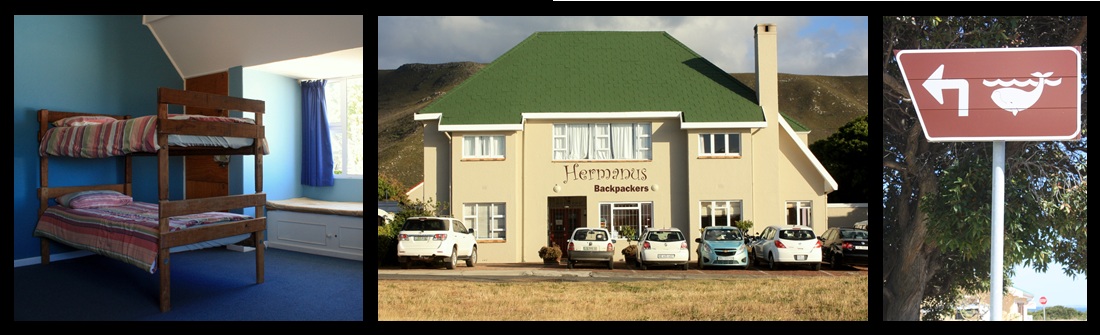
Hermanus Backpackers:  One of the best backpackers in South Africa. 
A storm rolls in along the South African coast
A drizzly morning in Hermanus, South Africa
View of Hermanus from the cliff walk footpath
Wine Tasting in the nearby Hemel-En-Aarde (Heaven on Earth) Valley


On the Garden Route, Western Cape
En route to Tsitsikamma National Park:  Monkeyland and Birds of Eden
Baby season at Monkeyland:  Brown Capuchins, Ringtail Lemurs, and Chacma Baboons
Suspension bridge at Monkeyland (the longest in Africa!)
Some of the friendly birds at Birds of Eden
Blue crane, lake, and pagoda in the largest single free-flight aviary in the world


Tsitsikamma National Park, Eastern Cape
Third Stop:  Tsitsikamma National Park
Tsitsikamma National Park and Storm's River Mouth

Just a few kilometers wide, Tsitsikamma National Park stretches for more than 80km along the southern coastline of South Africa.  It is home to steep cliffs, winding paths, and dangerous, crashing surf.  It is also home to the five-day Otter Trail (on which reservations should be made several months in advance).  Located at the far eastern end of the park, Storm's River Mouth is a rest camp that offers several hikes and camping along the sea.


Fun Fact

Just west of Tsitsikamma National Park is Bloukrans Bridge, location of the world's highest bungee jump (709 feet)


Favorites

Watching the sunrise, sunset, and crashing waves from our camp on the shoreline

Crossing the Suspension Bridge, a three-part hanging bridge that spans the rough water at the mouth of the Storms River


Next Time

Set time aside for the 5 day, 4 night Otter Trail-- South Africa's most popular hike.  Winding, wild, and unspoiled, this hike only allows 12 people at a time on any given section of the trail.

Camping along the shoreline in Tsitsikamma National Park
Camping in Tsitsikamma
Two of three hanging bridges above the river mouth
Lovely bridges at Tsitsikamma
Lovely flowers at Tsitsikamma


Drakensberg Mountains - Royal Natal - Lesotho
Fourth Stop- The Drakensberg Mountains
The Mountains

Rising to more than 11,000 feet in altitude, the Drakensberg Mountains are the highest mountains in southern Africa.  Three large parks-- Southern Drakensburg, Central Drakensburg, and Royal Natal National Park-- encompass the mountain range along the border between South Africa and Lesotho.

Royal Natal National Park

Royal Natal National Park exists as a series of gorges, hills, and rivers in the basin below the northern peaks of the Drakensberg Mountains.  The most striking feature of this park is the backdrop-- the Amphitheatre cliff face rises 4,000 feet above the valley floor and towers more than three miles wide.  

Lesotho

Pronounced (Leh-su-tu), this country is a landlocked enclave located entirely within the country of South Africa.   The entire country is situated at altitude, and the country's lowest point (1,400 meters) is the highest in the world.  Most of the population of Lesotho identify themselves as Basotho and speak the main language of Sesotho.  The country regularly receives snowfall in the wintertime, with some of the higher elevations receiving snowfall throughout the year.  


Fun Facts

The Drakensberg Mountains protect more than 35,000 San (Bushmen) works of art.

Royal Natal National Park is home to Tugela Falls, the second-highest waterfall in the world.

There is a growing campaign within Lesotho that seeks to see the Kingdom of Lesotho reabsorbed by the Republic of South Africa. 


Favorites

Enjoying three-course meals at the Amphitheater Backpackers.  Specialties include mint pea soup, Greek moussaka, and malva pudding

Taking a day trip into Lesotho (operated through Amphitheatre Backpackers)

Hiking the Tugela Gorge Trail in Royal Natal National Park


Next Time

Visit more of the Bushman paintings in the Central Drakensbergs

Hike along the top of the Amphitheatre wall

Beautiful rooms at The Knoll Backpackers (Pietermaritzburg, on the way to the Drakensberg Mountains)
The Drakensberg Mountains (along Tugela Gorge in Royal Natal National Park)
Amphitheatre Backpackers:  Jacuzzi tub, private room, and pool table
(Not pictured:  climbing cave)
Hut in Lesotho
Cows and massive vistas-- Lesotho
High wind at 8,000 feet-- Lesotho
San (Bushmen) paintings.  Hard to decipher, but it is possible to make out the eland on the right,
small dancing figures on the far right, and thin, towering humanoids on the far left.
Our Lesotho tour bus
Houses and beautiful scenery-- Lesotho
Lesotho kids
Hiking in Royal Natal National Park (Tugela Gorge)
Fresh flowers in the rain (Royal Natal National Park)


Kruger National Park
Final Stop:  Kruger National Park
Kruger

At over 7,500 square miles, Kruger National Park ranks amongst the largest National Parks in the world.  With 147 species of large mammals (more than any other African game reserve), Kruger is one of the premier Safari destinations in all of Africa.

Important Facts

Kruger's elephant population is getting so large (more than 12,000 individuals and growing at a rate of 7% per year) that the elephants are quickly outgrowing their ecosystem.  Debate over culling is still raging strong, but most experts seem to agree that a mass culling will be necessary to maintain the health of the park.   Culling was standard practice from 1967-1994.

Kruger has over 48 metric tons of ivory in storage.  Profits from ivory sales are used to help combat poaching activity in the park.

Rhino poaching is on the rise.  A poaching crisis in South Africa has seen 633 white rhinos killed in the year 2012.  The number of rhino killed has skyrocketed in recent years, jumping from 333 in 2010, to 448 in 2011, to the current count of 633.


Favorites

Taking an early morning drive with a ranger (3:15AM start!).  Nobody else had booked this drive, so we had the vehicle all to ourselves!

Viewing wildlife from the rest camp viewing decks.

Spotting baby animals (baby elephants, baby monkeys, baby zebra, and baby rhinos).


Next Time

Find a leopard

Safari Tent in Lower Sabie Rest Camp
Jamie and Drew (and our driver) on a Sunrise Drive
Our driver demonstrates a fat green "mopani worm."  "It's delicious," he says.  "Trust me."
Safari car
Restaurant and Observation Deck at Lower Sabie Rest Camp.  Elephants, wildebeests, zebras,
hippos, and crocodiles are all common visitors to the area.  
Our rental car, packed to the brim
Elephants crossing the roadway
Buffalo stare down the car as we drive slowly through the herd
Early morning hippo tracks!
A troop of baboons wander slowly down the road
Zebra, warthogs, and baboons


Return to Johannesburg - Bus to Maputo
End of Adventure!

After several long and bouncy bus rides, we finally made it back to our house in Zobue.  We are cheerfully (or at least stoically) readjusting to bugs, bucket baths, and the smiling, sticky faces of the under-10 crowd.  It's good to be home!  We'll be here for a few days before striking out again for the holidays.

Stay tuned for our next adventure-- Island Christmas!

Friday, November 16, 2012

South African Holiday

It's summer vacation in Mozambique.  As such, Dan and I are hitting the road for a
bit of South African adventure. Here is a sneak peek at our itinerary!  We will be flying 
from Lilongwe to Cape Town, renting a car, and making our way home over the 
course of several weeks. Traveling with us are Jamie, a fellow volunteer, and Drew, 
her boyfriend of seven years.  Expect pictures, stories, and more!

(I will be out of contact from November 19 to December 15)

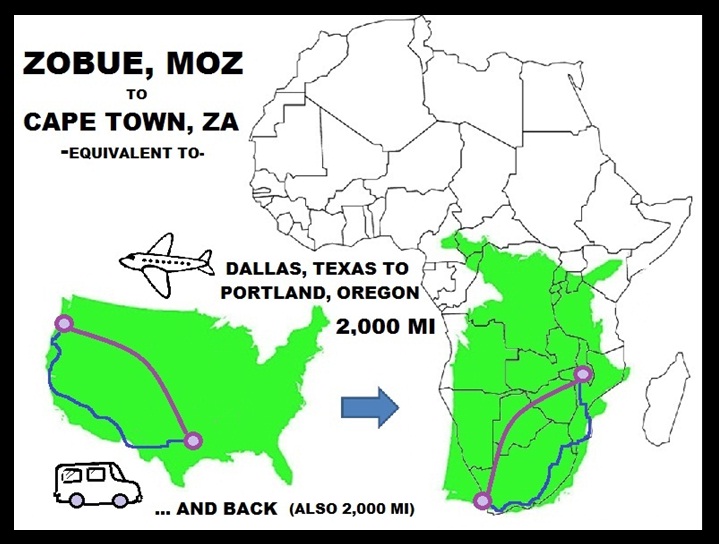
Zobue, Mozambique to Cape Town, South Africa

South African Itinerary:  Cape Town (A) to Hermanus (B) to Storms River Mouth (C) to Pietrmaritzburg (D) to Royal Natal National Park (E) to Blyde River Canyon (F) to Kruger National Park (G)

Cape Town, South Africa

Cape Town, South Africa:  Gardens, Penguins, Seafood, and Table Mountain

Hermanus, South Africa:  Self-proclaimed "Whale Capital of the World"

Hermanus, South Africa:  Also Home to Shark Diving

Drakensberg Mountains:  Hiking and Camping in Royal Natal National Park

Kruger National Park:  4 days on Safari

Back in Four Weeks!

Wednesday, November 14, 2012

The Seven Wonders of Modern Zobue

This travel blurb is dedicated to Kristen Sloyer and Vikram Rastogi, who were fantastic guests, intrepid explorers, and model site visitors.  Thanks guys, and congratulations on your new site placements!

Site Visits:  November 2012

Overview:

Zobue (actually spelled Zóbuè or Zobwe) is a town of approximately 8,000 people in eastern Tete Province, hugging the border between Mozambique and Malawi.  The town itself is small and unassuming-- the main stretch of road is about one kilometer in length-- and stretches from the border post in the east to the edge of town in the west.  After the hospital and Catholic Church, the town seems to fall away, and the landscape becomes one of expansive low vegetation, rocky outcroppings, and towering baobab trees.  Villages between Zobue and Tete City (127 kilometers-- 2 to 4 hours) are simple and sparse, giving Zobue an air of isolation and self-sufficiency.

Although Zobue seems small and unremarkable, don't be fooled.  Beneath its simple exterior is a town bursting with good food, culture, and good hikes.  The dedicated tourist should consider staying for at least two days (if not more) in this charming country town.

Weather and Seasons:

The Tete/Malawi border is known for its "fresco" weather and for its fertile soil.  A wide range of crops are available throughout the year, and most families own and maintain their own fields and gardens.  The rainy season provides natural irrigation between October and March-- the time period in which Zobue is most green and productive-- and the dry season hosts a short, brisk winter between the months of May and July.

Location and Accommodation:

Because Zobue is situated along a main corridor (Route 103 from Blantyre, Malawi to Harare, Zimbabwe), there is a healthy amount of cross-traffic and visitation.  Visitors will often stay for a night en-route to Malawi, and Peace Corps Zobue has hosted quite a few long-distances travelers.  Based in a safe and bustling bairro on the upper edge of town, Peace Corps Zobue boasts room enough for 8-10 visitors, six of whom can sleep in relative peace and comfort.  Accommodation is complete with bedding, mosquito nets, all-you-can-drink filtered water, and a free egg sandwich in the morning.

The Seven Wonders of Modern Zobue:

Though Zobue has been carelessly neglected by the likes of Frommer's and Lonely Planet, it deserves to have its own special travel description.  Inspired in part by our site visitors, who stayed for four full days in early November, I have decided to write my own description of Zobue, outlining the must-see aspects of our rocky little town.  Peruse and enjoy-- The Seven Wonders of Modern Zobue.

(Now with Printable Postcards!)


#1:  Quinta Monte Zobue


Located in the fields at the far end of town, Quinta Monte Zobue rests in the shadow of the Angonian Plateau.  Tables in the gazebo offer sweeping views of the foothills and exposed, weathered domes, including an opportunity to spot two of Zobue's famous international border markers.

Supply at this restaurant/hotel is occasionally limited, but visitors can reliably find good prices on chicken and gazelle.  The beer is usually cold, the nsima is usually hot, and their nightly projector show (music videos, Titanic, or old Kung Fu movies) is not to be missed.


#2.  Sunset Rock


No trip to Zobue would be complete without a hike to the fabulous Sunset Rock!  Arguably the best sunset spot on the entire Planet Earth, these domes are located in the hills of "No Man's Land" on the border between Mozambique and Malawi.  Quiet, peaceful, and warm to the touch, these black rocks are relatively isolated from the rest of the town and offer expansive views across the mountains of Tete Province.


#3.  The Nyau


Unpredictable and fierce, the Nyau are the cultural dancers of the Chewa tribe.  A lucky visitor might spot these dancers in the early evening hours, running armed and rampant through the bairros.  It is customary to flee before a charging Nyau, and "dancing days" generally result in general panic, excitement, and a town-wide game of hide-and-seek.  To find the Nyau, listen for drums, shrieks, and rattles.  As with animals on safari, a sighting cannot be guaranteed.


#4.  Malawi


With the nearest Malawian town located less than 8km away, a day trip into Malawi is a fantastically tempting option.  Among its many perks, Malawi offers good food, cheap Coke, and English-speaking residents.  The taxi ride between the borders is just one highlight of the trip, where the views of the countryside are usually glimpsed at 150km per hour to the tune of Chewa Rock.  After your exciting, ten-person taxi ride, don't forget to check in at the second border station on the Malawi side of "No Man's Land".    From there, you are free to explore the BOMA (central market area) and surrounding neighborhoods.  It's fun to greet people in English and to identify differences between Mozambican and Malawian culture.  Even better, it's fun to say that you've been to Malawi.


#5.  Abandoned Seminary and Other Hikes


For the long-term guest or adventurous visitor, Zobue also offers a spectacular suite of hiking options, from the precipitous climb across the "Back Zobue Spine" to the beautiful Seminary hike.  Visitors looking for a more in-depth experience should state their preferences to the proprietors at Peace Corps Zobue.  Hikes on offer include:

  • The Back Zobue Spine (5 kilometers to a series of cliffs and boulders overlooking the surrounding hillside)
  • The Seminary Hike (8 kilometers to a hidden, abandoned Catholic Seminary.  Spooky!)
  • The Village Meander (10 - 30 km through the countryside and nearby villages)
  • The Land Mine Prod (a 100 km march straight through the surrounding bush)


#6.  The Zobue Secondary School


A quintessential part of the Zobue Guest Experience is a quick side-trip to the Zobue Secondary School!  Just three minutes from the Peace Corps Zobue house, the Secondary School offers a glimpse into student life in Mozambique.  Visitors are welcome to enter the classrooms, take a seat, and receive a demonstration of Mozambican school protocol!  This is immersion tourism at its best.

#7.  Monte Zobue


The crowning jewel of the Mozambique/Malawi border, Monte Zobue is the ultimate Zobue destination.  Visible from more than 40km away, it is the world's only triple-dome mountain (located within the town of Zobue).  A hike to the top of the smallest dome can be done in fewer than three hours, and every local child knows the way. Longer hikes probe the depths of the cloud forest between the domes, so keep your eyes peeled for monkeys and parrots!  Proper footwear is recommended.


Congratulations on finding Zobue, Mozambique:  "The Best Site in Eastern Tete!"  Drop us a line, give us a call, or come explore with us today!

Springtime

It's spring in Mozambique!

Spring rains bring this tuft of grass to life


The rainy season started with a few good rains in late October.  Within days, spring had unfurled across the countryside of Mozambique and produced quantities of new growth.  While our water supply hasn't completely recovered, there is now enough moisture in the soil to support seedlings and flowers.  A recent trip to the mountain yielded fresh grass, full sun, and thousands of beautiful, smiling (botanical) faces.  


New growth
Acacia:  In full bloom on November 3, then with fresh leaves on November 10
Flowers on the mountain
A "fireball," or African blood lily
Flowers on the mountain
Spring also means baby animals, like this baby praying mantis

End of the School Year

Two Teachers

After three full trimesters, 40 weeks of classes, five days of national exams, two rounds of divulgação (trimester grade announcements), and one giant, public, hand-written, grade-wide report card, Dan and I have made it to the end of our first school year in Mozambique!

While it has been exhausting and intense, it has also been wonderful and enlightening.  I now know that I do want to be a teacher and that I’m headed in the right direction.  While I prefer to teach the younger grades (second and third grade at the State College Friends School was perfect), I am thankful that I was selected to be an eighth grade teacher and not a teacher at the ninth, tenth, or second-cycle level.  My students are still young enough to be playful and sweet, and that is something that I really appreciate and take advantage of.

Dan, for his part, has learned that he definitely wants to go back to school and continue teaching at the college level.  While he enjoys his eighth and tenth grade students, I think that he misses “real” math.  He hopes to re-take his college entrance exams and apply to the University of Washington next fall.

Besides learning a lot about ourselves, we have learned a lot about the Mozambican school system.  It has taken an entire year, but I finally feel like I understand my school and the systems that are in place.  I understand what my role is, and in what ways I can make a contribution.  I feel capable, strong, and confident.  This year, I hit the ground watching.  Next year, I will hit the ground running.

This is what I have learned about teaching in Mozambique:

1.  Be strict.  It is better to start off strict and ease off later, rather than the other way around.  Classroom discipline was the biggest challenge that I faced this year, and it got much worse towards the end of the year.  Establish a pattern of behavior and response.

2.  Be fair.  Listen to your students.  You can’t constantly make allowances or amendments to your rules, but students appreciate a teacher who is fair and just.  Some Mozambican students have extraordinary home situations and need a little extra help.

3.  Make mistakes.   Nobody is perfect.  Mistakes help you iron out your methodology.

4.  Ask for advice.  The other teachers know better than you do.  This is their school and their country.

5.  Laugh.  It’s okay!

“To teach is to learn twice.” ~Joseph Joubert, 1842


Escola Secundaria de Zobue:  Zobue Secondary School

Inside the classroom

Dan teaching eighth-grade math

Meet our students!  Creating student ID cards for the national exams.

Example Student ID.  Made using MS Powerpoint!  Very official.


Now that I have finished my first school year and I am beginning to consider my second, I am ready to think about the goals and improvements that I would like to make.  In terms of teaching, my goals for next year are as follows:

1.  Teach eighth-grade English (again)

I’ve discovered that I don’t really like teaching English!  English as a subject is nearly infinite, and I often feel like I am paddling frantically just to stay in the same place.  Many of my students have yet to actually master Portuguese, and, as such, my task (that is, building upon their Portuguese to teach a third level of language) seems nearly impossible.  I am looking forward to my second year, however, because I will be much more competent and effective.  Thankfully, English is a fun disciplines, and most students get pretty excited about it.  English lends itself easily to lots of games and songs, and for that I am grateful!

2.  Teach ninth-grade Geography

There is an opening next year for a ninth-grade Geography teacher, and I have requested to take the position.  I very much like geography (in this case, world geography) and feel like I would be a very effective instructor.  If my request is accepted, I will be teaching ninth-grade Geography in the morning and eighth-grade English in the afternoon.  Even better, I would “move up” with my eighth grade students.

3.  Start an English Club

Dan and I hope to start an English Club with a selected handful of ninth-grade (previously eighth-grade) students.  This club will be the starting point for next year’s English Theater group, and will offer extra work to help challenge some of our best and brightest students.

4.  Learn to Say, “No”

There are several projects that I hope to “graduate” next year, including REDES (to be left in the care of my counterpart, Inacia) and Informatica (to be left in the care of my counterpart, Sopa).  While I really liked teaching computers, I prefer to teach to large groups.  I also prefer geography.


This week marks the official start of summer vacation, which will last until January 14th.  And although our main responsibilities are at the school, this two-month respite does not mean that Dan and I will be idle.  Here are a few things on our agenda:


  • Blog Posts!  Pictures, information, pleas for money, and more!
  • South Africa!  Cape Town to Kruger in 18 days!
  • Northern Mozambique!  Dolphins, Seafood, and Rough Roads!
  • Mozambique Mosaic!  My photos make their way to Zobue!

 Stay tuned, and have a WONDERFUL SUMMER VACATION!

Thursday, November 1, 2012

In the name of Africa, Children, and Basketball

Dan is building a basketball court in the town of Zobue, Mozambique!

I'm excited to announce that Dan's basketball project (CABAZO) has been posted on the Peace Corps website and is now accepting funds.  The project has already raised $800 dollars, and we hope to reach $5,000 by the end of December.   Read on!

What is CABAZO?
Short for Campo de Basquetbol em Zobue, the CABAZO project aims to build a concrete basketball court in the semi-rural town of Zobue, Mozambique.  

Why basketball?
Basketball is a popular sport in the more affluent corners of Mozambique, but most village kids never really get a chance to learn how to play.  While the students and teachers have an abiding interest in basketball, the nearest court is actually 5 miles away (and in the adjacent country).  The CABAZO project hopes to bring basketball to Zobue and to start a traveling, competitive, after-school sports league.

CABAZO is based on the principle that competitive sports promote
  • A strong sense of self-esteem and personal achievement
  • Healthier lifestyles and healthier choices
  • Opportunities 

Why Zobue?
Zobue has been trying to build their own basketball court for years.  The town had already bought a patch of land on which they hoped to build their court, but were lacking in the necessary funds.  In their enthusiasm for the project, the local secondary school has offered to contribute half of the total value (mostly in terms of bricks, sand, and manual labor).  

When Dan first launched his CABAZO campaign at a school meeting in April, he received a standing ovation from the other teachers in attendance.  

Who is the target audience?
Working together with other teachers at the school, Dan hopes to start a after-school competitive league for eighth, ninth, and tenth grade students, as well as a recreational league for adults.  The secondary school also hopes to incorporate the basketball court into its physical education curriculum.  The goal is to provide a healthy recreational alternative (that is, a fun after-school sport) for teenagers at risk.  

What about me?
If you are interested in donating to the project, you can find more information on the website for the Peace Corps Partnership Program.  Every single penny goes towards buying cement, poles, hoops, and rims.  If, for whatever reason, we have extra funds, the money will be put towards paint, jerseys, and basketballs.  Here in Africa, every dollar counts.


Take a good look at these "Before" and "After" photos.  Consider the difference that your money could make!

From this little rascal, to the unshakable Shaquille O'Neal
From our neighbor Joaquim, to the unbeatable Larry Bird 

And, whether or not you choose to donate, please enjoy the following short video selection. From the 1980 comedy classic, Airplane, this scene shows two young Peace Corps volunteers as they try to "teach" basketball to an indigenous African tribe.


If you have donated, please let us know.  Your contribution is incredibly meaningful, and we want to thank you.  The neighborhood kids are making home-made cards for each and every one of our special donors!  Feel free to leave a comment below or to send a private email.


Thank you!  Obrigada!  Zikomo Kwambiri!