Wednesday, November 14, 2012

End of the School Year

Two Teachers

After three full trimesters, 40 weeks of classes, five days of national exams, two rounds of divulgação (trimester grade announcements), and one giant, public, hand-written, grade-wide report card, Dan and I have made it to the end of our first school year in Mozambique!

While it has been exhausting and intense, it has also been wonderful and enlightening.  I now know that I do want to be a teacher and that I’m headed in the right direction.  While I prefer to teach the younger grades (second and third grade at the State College Friends School was perfect), I am thankful that I was selected to be an eighth grade teacher and not a teacher at the ninth, tenth, or second-cycle level.  My students are still young enough to be playful and sweet, and that is something that I really appreciate and take advantage of.

Dan, for his part, has learned that he definitely wants to go back to school and continue teaching at the college level.  While he enjoys his eighth and tenth grade students, I think that he misses “real” math.  He hopes to re-take his college entrance exams and apply to the University of Washington next fall.

Besides learning a lot about ourselves, we have learned a lot about the Mozambican school system.  It has taken an entire year, but I finally feel like I understand my school and the systems that are in place.  I understand what my role is, and in what ways I can make a contribution.  I feel capable, strong, and confident.  This year, I hit the ground watching.  Next year, I will hit the ground running.

This is what I have learned about teaching in Mozambique:

1.  Be strict.  It is better to start off strict and ease off later, rather than the other way around.  Classroom discipline was the biggest challenge that I faced this year, and it got much worse towards the end of the year.  Establish a pattern of behavior and response.

2.  Be fair.  Listen to your students.  You can’t constantly make allowances or amendments to your rules, but students appreciate a teacher who is fair and just.  Some Mozambican students have extraordinary home situations and need a little extra help.

3.  Make mistakes.   Nobody is perfect.  Mistakes help you iron out your methodology.

4.  Ask for advice.  The other teachers know better than you do.  This is their school and their country.

5.  Laugh.  It’s okay!

“To teach is to learn twice.” ~Joseph Joubert, 1842


Escola Secundaria de Zobue:  Zobue Secondary School

Inside the classroom

Dan teaching eighth-grade math

Meet our students!  Creating student ID cards for the national exams.

Example Student ID.  Made using MS Powerpoint!  Very official.


Now that I have finished my first school year and I am beginning to consider my second, I am ready to think about the goals and improvements that I would like to make.  In terms of teaching, my goals for next year are as follows:

1.  Teach eighth-grade English (again)

I’ve discovered that I don’t really like teaching English!  English as a subject is nearly infinite, and I often feel like I am paddling frantically just to stay in the same place.  Many of my students have yet to actually master Portuguese, and, as such, my task (that is, building upon their Portuguese to teach a third level of language) seems nearly impossible.  I am looking forward to my second year, however, because I will be much more competent and effective.  Thankfully, English is a fun disciplines, and most students get pretty excited about it.  English lends itself easily to lots of games and songs, and for that I am grateful!

2.  Teach ninth-grade Geography

There is an opening next year for a ninth-grade Geography teacher, and I have requested to take the position.  I very much like geography (in this case, world geography) and feel like I would be a very effective instructor.  If my request is accepted, I will be teaching ninth-grade Geography in the morning and eighth-grade English in the afternoon.  Even better, I would “move up” with my eighth grade students.

3.  Start an English Club

Dan and I hope to start an English Club with a selected handful of ninth-grade (previously eighth-grade) students.  This club will be the starting point for next year’s English Theater group, and will offer extra work to help challenge some of our best and brightest students.

4.  Learn to Say, “No”

There are several projects that I hope to “graduate” next year, including REDES (to be left in the care of my counterpart, Inacia) and Informatica (to be left in the care of my counterpart, Sopa).  While I really liked teaching computers, I prefer to teach to large groups.  I also prefer geography.


This week marks the official start of summer vacation, which will last until January 14th.  And although our main responsibilities are at the school, this two-month respite does not mean that Dan and I will be idle.  Here are a few things on our agenda:


  • Blog Posts!  Pictures, information, pleas for money, and more!
  • South Africa!  Cape Town to Kruger in 18 days!
  • Northern Mozambique!  Dolphins, Seafood, and Rough Roads!
  • Mozambique Mosaic!  My photos make their way to Zobue!

 Stay tuned, and have a WONDERFUL SUMMER VACATION!

Thursday, November 1, 2012

In the name of Africa, Children, and Basketball

Dan is building a basketball court in the town of Zobue, Mozambique!

I'm excited to announce that Dan's basketball project (CABAZO) has been posted on the Peace Corps website and is now accepting funds.  The project has already raised $800 dollars, and we hope to reach $5,000 by the end of December.   Read on!

What is CABAZO?
Short for Campo de Basquetbol em Zobue, the CABAZO project aims to build a concrete basketball court in the semi-rural town of Zobue, Mozambique.  

Why basketball?
Basketball is a popular sport in the more affluent corners of Mozambique, but most village kids never really get a chance to learn how to play.  While the students and teachers have an abiding interest in basketball, the nearest court is actually 5 miles away (and in the adjacent country).  The CABAZO project hopes to bring basketball to Zobue and to start a traveling, competitive, after-school sports league.

CABAZO is based on the principle that competitive sports promote
  • A strong sense of self-esteem and personal achievement
  • Healthier lifestyles and healthier choices
  • Opportunities 

Why Zobue?
Zobue has been trying to build their own basketball court for years.  The town had already bought a patch of land on which they hoped to build their court, but were lacking in the necessary funds.  In their enthusiasm for the project, the local secondary school has offered to contribute half of the total value (mostly in terms of bricks, sand, and manual labor).  

When Dan first launched his CABAZO campaign at a school meeting in April, he received a standing ovation from the other teachers in attendance.  

Who is the target audience?
Working together with other teachers at the school, Dan hopes to start a after-school competitive league for eighth, ninth, and tenth grade students, as well as a recreational league for adults.  The secondary school also hopes to incorporate the basketball court into its physical education curriculum.  The goal is to provide a healthy recreational alternative (that is, a fun after-school sport) for teenagers at risk.  

What about me?
If you are interested in donating to the project, you can find more information on the website for the Peace Corps Partnership Program.  Every single penny goes towards buying cement, poles, hoops, and rims.  If, for whatever reason, we have extra funds, the money will be put towards paint, jerseys, and basketballs.  Here in Africa, every dollar counts.


Take a good look at these "Before" and "After" photos.  Consider the difference that your money could make!

From this little rascal, to the unshakable Shaquille O'Neal
From our neighbor Joaquim, to the unbeatable Larry Bird 

And, whether or not you choose to donate, please enjoy the following short video selection. From the 1980 comedy classic, Airplane, this scene shows two young Peace Corps volunteers as they try to "teach" basketball to an indigenous African tribe.


If you have donated, please let us know.  Your contribution is incredibly meaningful, and we want to thank you.  The neighborhood kids are making home-made cards for each and every one of our special donors!  Feel free to leave a comment below or to send a private email.


Thank you!  Obrigada!  Zikomo Kwambiri!

Sunday, October 14, 2012

Hair

Caucasian hair, African hair, Caucasian hair

So I have pretty typical "white girl" hair.  It's fine, straight, and sort of limp.  I struggle with flatness and grease and a lack of ideas.  I never really know what to do with it, so usually I just tie it back.  Out of sight, out of mind, right?

I didn't really understand African hair when I arrived in Mozambique, either.  It took me months to realize most of the long hair that I was seeing was fake, and that women would change their hair on a month-to-month basis.  It was impossible to remember who was who just by identifying hair, hair color, or hair styles.

Four little girls with four different hair styles

After living in Mozambique for more than a year, I have learned a lot about styling African hair.

Here is what I have learned:

African hair is super, super curly!  It generally grows more slowly than other hair types, and is more prone to breakage.  To counter this, boys usually keep their hair very short.  Girls wear their hair in short, temporary styles or braid in lengths of fake hair.

Short styles include braids, spirals, spikes, and puffs.  Hair is held in place with clips, beads, caterpillar hair ties, or bits of string.  Because the hair is so coarse, braids will stay in place without being tied.  To create longer hairstyles, hair can be bought and braided into the original hair.  This process takes hours and often yields beautiful lengths of (semi) natural-looking hair.


Short, natural hair: Braids
Short, natural hair:  Spikes
Short, natural hair:  Unstyled
Short, natural hair:  Spikes and Poofs
Short hair extensions
Medium-length hair extensions
Long hair extensions
Fancy hair extensions
Long, natural-looking hair extensions

Women usually change their hair every few weeks.  Because of the cost and effort that it takes to braid in longer extensions, little girls usually just wear short, natural hairstyles.  For little girls, long hair is a mark of maturity.  For older women, well-managed hair is a sign of prestige.  

Here are a few extra facts about hair in Mozambique:
  • Peace Corps volunteers are often asked for their hair!  My neighbors are especially fond of my yellow "American" hair, and have requested that I leave some of it behind when I am finished with my service.   Since it's already 12 inches long (with more than one year left to grow), I am considering it.  
  • Hair extensions can be expensive and they can take hours to tie in.  Because of this, extensions will often be added over the course of several days.  It's not uncommon to see girls walking around with long, raggedy mullets while they wait for the rest of their braids to be finished.
  • Mozambicans are really fastidious about their hair.  A fantastic punishment for secondary school teachers is the old "eraser bop."  Kids hate having chalk dust in their hair!   
  • Little boys rarely grow out their hair, but they are expected to comb it.  Sometimes, if boys don't brush their hair, they get sent home from school as a punishment for being "untidy."  It always looks the same to me, though.
  • Our 6-year old neighbor once begged his mother to let him grow out his hair to look like "Dani." She has flat-out refused him, arguing that his hair would absolutely NOT look the same.  Junho is still not convinced.  

Final Challenge:  It can be really difficult to recognize somebody after they have drastically changed their hair!  This was a huge problem for me in my first few weeks as a teacher.   Can you tell which (older) girl is actually shown twice in the pictures above?  

Monday, October 8, 2012

English Theater 2012

The English Theater venue

My primary assignment is to be an eighth-grade English teacher.  For fifteen hours a week, I am in the classroom.  I teach nouns and adjectives and gerunds and grammar to five overstuffed turmas of rowdy African children.  It has become a part of my life, and I love it.

Every weekday morning, I also teach Informatica.  For between two and three hours a day, I squeeze into my school's tiny "computer lab" and teach computers to adults in my community.  Most of my adult students have never used a computer before, so we start from the very beginning.  It's a huge challenge (and executed entirely in Portuguese), but I love it as well.

In addition to these primary projects, Dan and I are also expected to maintain several active secondary projects.  As volunteers, Dan and I are involved in REDES (girl's empowerment), Science Fair, and English Theater.  We have both agreed to take on positions of responsibility for the 2013 school year, making Dan the Science Fair national co-coordinator and me the provincial coordinator for English Theater. It will be a lot of work, but we are both looking forward to it.  While these extra projects can be exhausting and time-consuming, we are also discovering that they can be a lot of fun.

English Theater is a particularly popular secondary project in the country of Mozambique.  As my predecessors so succinctly put it:

"Mozambicans really love theater and Mozambicans really love English, so English Theater is the perfect Peace Corps project."

This is absolutely true.  What I didn't expect, however, was how much I would love English Theater, or how proud I would become.  What started as a rag-tag team of eighth-grade students became the most diligent little club that I have ever seen-- and the highlight of my first year at site.

The kids wait for the show to begin

Our English Theater group consisted of ten students:  five girls and five boys.  Six of these students were my eighth graders, making our group one of the youngest to compete in this year's competition.  Trust me when I say that, compared to the rest of the competitors, my students were little itty-bitty.  Our group might not have been the most well-spoken, but they were definitely the cutest.

The theme for this year's play was "We are all Equal!"  This could have translated into any number of topics (race equality, gender equality, HIV/AIDS awareness), but my counterpart chose to write a play about orphans.  Armed with a thirty-minute script that later had to be trimmed to bits, my counterpart then selected two of our smallest members to play a pair of maltreated orphans.  For the first few weeks, it was absolute mayhem.  We were trying to squeeze ten different scenes into a ten-minute play, and most of the performance seemed to showcase extra-small eighth-graders running frantically on- and off-stage.

Towards the end of September, the play started to take form.  It was clear that the students had been practicing at home.  They could now say their lines with quite clearly ("You are maltreating us because we are orphans!") and they usually remembered to speak clearly and to face the audience.  I was proud of them, and I let them know it.  For most of these kids, this was their first performance piece, ever.


The introductory performance

On the day of the competition, our group met at 5AM.  Dan and I herded all of the kids onto a chapa bound for Moatize, then sandwiched ourselves between ten noisy teenagers.  The next two hours were spent singing songs, jostling props, and running lines.

"Speak ENGLISH," instructed one of the oldest kids.  "This is the ENGLISH THEATER minibus."

Once in Moatize, we piled out of the chapa and began to help set up.  The competition was being held at a big, fancy mission (with a stage!) but there was still a lot of work to do.  My kids were asked to hang posters, arrange benches, and blow up balloons.  They loved it, of course, and spent the next hour wrestling with a large bag of party balloons (which was, in itself, a fairly foreign concept) and sticking them to the wall with a combination of Bostik and bubblegum.

At about 9AM, the competition was called to order.  We kicked off the ceremonies with a rendition of the Mozambican National Anthem, then drew school names from a hat to determine in what order the groups would be performing.

Zobue was selected to go first.

The Zobue English Theater Group:  Osvaldo (the orphan) and Requito (the cruel uncle)

By the time that the kids were ready to go on-stage, I didn't have a lot of advice to give them.

"Just yell," I said.  "Be really loud!"

And yell they did.  For the next ten minutes, the stage was filled with tiny, noisy children, shouting their lines as loudly and as clearly as they could.  Sometimes they got confused and messed up ("You are maltreated us because we are orphans BECAUSE!"), but the audience was going wild.   In the final scene, where the youngest orphan jumps into the arms of the kindly stranger, the entire auditorium burst into applause.


The Zobue English Theater Group:  The ophans (center) announce their intention to continue their eduction.  Orphans go back to school, graduate with honors, and become very rich.  End of play!

In the end, the Zobue English Theater group took third place (out of eight competing groups), along with the prize for "Most Creative Performance."  My kids each got three certificates, an English Theater T-shirt, and an English-Portuguese mini dictionary.  Every single one of my students was grinning from ear to ear.


Back in Zobue, we were treated like heroes.  The Director of the School collected every certificate from every one of my students and handed them back in a very solemn, official, school-wide ceremony.  The kids have been wearing their English Theater shirts every day for the past week and "cool" English phrases have been popping up on the blackboards in every classroom:

         
"How to Use Your Oxford English-Portuguese Mini Dictionary"

                                         and

"Oxford is a Registered Trademark of Helix Publishers, Ltd"


Even better, I have been approached by about fifteen eighth-grade students, all of whom have asked if they can join the group next year, too.  


The girls of English Theater show off their certificates

English Theater was a very meaningful and fulfilling experience.  I'm so proud of my eighth-grade students and I am excited to do it all again (and better) in 2013!

My students are excited, too.

Teacher Lisa and the Zobue English Theater Group

Wednesday, October 3, 2012

One Year

Dan and I have been living in Mozambique for one full year!  

These past twelve months have been, more than anything else, a time of discovery and tremendous personal growth.  Sometimes I feel like I am here just to observe-- to watch and to take in the things that I see.  

"I become a transparent eyeball; I am nothing; I see all..."  
 Ralph Waldo Emerson


Through watching, I have learned a great deal.  I have learned that-
  • Little boys and little girls are the same, all over the world
  • Mozambicans are very, very social and are rarely alone
  • This country is generally optimistic, cheerful, and full of hope

During this past year, I have also learned a lot about myself.  As an American girl living as a foreigner in a new country, I have started to see myself through the eyes of the people that I have met.

Let's take a look at the things that I have learned about myself and my country in the past year:


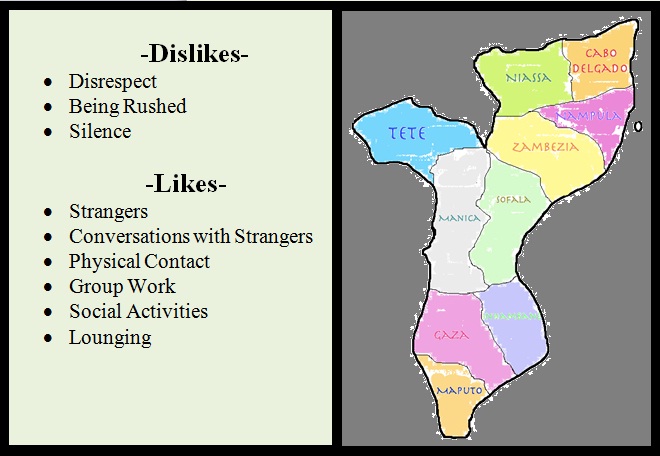
A Profile of Lisa Jo Spencer


Profile of Mozambique


It's been a big year:  a year of pictures, of friendships, and of challenges.  This is the year that I learned Portuguese.  This is the year that I learned how to be a teacher.  This is the year that I set out to change the world and I changed myself, instead.

Successes:

  • Learning Portuguese
  • Becoming well-known in the community
  • Getting published
  • Completing my first year as a teacher

Challenges:

  • Class discipline
  • Loneliness/Homesickness

Photos:  One Year in Mozambique


Finally, I'd like to close out with a few statistics.  It's hard to encapsulate an entire year in just one blog entry, but I hope that these numbers will help define the scope of my first year in Mozambique and paint a picture of my daily life.  Enjoy!  Here's to another twelve months in Africa.

Communication


In the Classroom


On the Home Front


And in Closing...

Sunday, September 23, 2012

Time of Fire

September is hot and dry.  It has been more than three months since we last saw rain in the province of Tete and, as such, the scene is primed for fire.  Local farmers have been executing small-scale, localized burns to clear away weeds and to prepare for next year's growing season, sending pillars of smoke and grit to clog up the view along the horizon.  Half of Tete Province has burned at some point during the last few months and the air quality is horrible.  Zobue hasn't seen a decent sunset since July.  This is the "Tempo de Fogo" in Mozambique.

For the most part, the weeks have been passing without incident.  Most of the fires that we see are small, reasonable, and under control.  The few large fires that we do see are far on the outskirts of town, lighting up the night from their position on the mountainsides.  These fires, while threatening, always seem to dissipate by morning.

Yesterday, though, we had a pretty big event.  At about 10 o'clock in the morning on Saturday, September 22nd, the entire Zobue marketplace burst into flames.

We heard about the fire just minutes after it had happened.  A crowd of neighborhood children came barreling into our front yard, babbling and shouting at Dan.

"TURN OFF YOUR ENERGY!"  They shouted.  "Turn it OFF!  Turn it OFF!"

Dan stuck his head out the door and cocked his head.

"What?"  He asked.

"There's been an accident in the marketplace!"  The children yelled.  "You have to turn off your energy or you will DIE."

After some discussion and clarification, Dan managed to piece together the entire story.

At about 9:30 that morning, a farmer was burning his land in the fields below the marketplace.  After successfully lighting the fire and getting it moving in the right direction, he walked away and let it burn.  It continued to burn merrily for about fifteen minutes without incident.  Then, at about 9:45, the wind picked up and began to blow the fire in the direction of the marketplace.

The fish stalls on the lower end of the marketplace were the first to catch fire.  The fire sent the bamboo poles and straw thatching up in flames and then lept towards the bancas by the road.  From there, it spread down the rows towards back of the market, taking down stores and stalls as it went.  The flames burned so high that they burned right through the electrical line, cutting power to the rest of the market and sending a shower of sparks over vendors as they ran back and forth to save their products.

There was some confusion, at first, about the situation with the power lines.  Some onlookers seemed to think that the fire was caused by a problem with the electricity, and that the whole town was going to burn down.  Waves of children were sent out across town, warning townsfolk to "Turn off their electricity or die." More credible witnesses, however, swore that the fire started in the fields.

"The flames were twenty feet tall," they said.  "The fire came first, and then it took out the power lines."

Dan and I came to see the damage at around sunset.  Everything was a mess.  The bamboo stalls on the lower side of the market had been razed completely.  The fire had spread uphill and destroyed a few tin bancas, burning to the top of several papaya trees on the outer edge of the market and even destroying a few brick bancas in the very center. 

The air was still hot and smoky.  A few timbers were still smoldering and sending out ash.  People were milling around and gawking.  Plenty of kids were out, playing in the ashes.  Nobody, it seemed, had been hurt.  Mostly, the fire just seemed to have created a lot of excitement.  The fire had happened hours before, but it was still a big event. 

We went to visit some of our friends in the marketplace, all of whom seemed to have escaped the worst of the damage.  Sebastion’s banca was an island in a sea of burned ground.  Jorge’s shop was fine, too, and Danny’s, as well. 

“Were you here?” I asked our friends, when we stopped by to visit.  “Did you run away?”

“Of course we didn’t run away,” they said.  “We had to protect our stores.”

We were glad to hear that nobody had been hurt, and we were relieved to see that so many of the big bancas had been spared. 

“Thank goodness the fire didn’t enter your store,” I said to Danny, looking around at the shelves of stock and products.  "You would have lost everything.  And you would have been trapped!  I can’t believe that you didn’t run away.”

“My whole life is in my store,” said Danny. 

Sebastion agreed, and then added:

“Run away?  I would rather die in my banca.”

We're still unsure about how many goods and products were actually lost in the fire.  Entire stalls were burned to the ground, but their owners escaped unharmed.  Did our friend Bright manage to escape with his stock of flip-flops and tupperware?  Did Raimundo escape with all of his capulanas?  What about Eric and his collection of cheap Chinese bras?  We weren't sure, and the owners were nowhere to be found.  

It was clear that the used clothes had burned too quickly to be saved.  The old boxcar that served as a calamidades storage shed was now nothing more than a twisted pile of tin and smoldering fluff.  

Our town's reaction has been interesting.  Most of the adults have been milling around, shaking their heads.  

"Terrible," they say.  "Just terrible."

Vendors are already hard at work, tearing down their old, ruined stalls and beginning to build anew.

The kids, on the other hand, seem to be pretty excited.  Hordes of children can be found in all corners of the market, pushing their toy cars through the cinders and scrounging for bottles and other broken things.  It's a dirty job, but their search yields all sorts of hidden treasures-- cans, glass, and bits of wire.  

Hope from the ashes, I guess.

The old market:  Bamboo stalls, thatched roofs, and plenty of flammable goods
The old market:  A shot of the market in February 2012.  Note the system of inter-connected thatched roofs
The new market:  A shot of the market after the fire
A view of the market after the fire
Sebastion's banca, ironically named "The Lonely Banca."
A view of the market (fish stalls) after the fire.  Note the missing electric line on the upper right.  It burned away.
A view of the  market (fish stalls) after the fire.  The fire started on the left-hand side of the frame and rapidly moved to towards the back.  
Remnants of a small, tin banca
The bread stall (left) and Jerusalem Banca (right).  A child picks through the ashes, searching for bits and toys.

Tuesday, September 18, 2012

Mozambique Mosaic

I find joy in taking pictures.


I am proud of the work that I do here in Africa, and, while that work primarily signifies my job as an eighth-grade English teacher, it also includes the pictures that I take and share with friends and family at home.  After all, the Third Goal of the Peace Corps Experience is to:

"Help promote a better understanding of other 
peoples on the part of the Americans"

Last month, I was giddy and honored to be contacted by an Jacqui Taylor, a Harare-based illustrator, about the use of my photos for her latest project.  The project, a book entitled "Mozambique Mosaic," is about the material art and culture of Mozambique.  It covers nearly every topic imaginable, from fishing and hunting to instruments and hand-made toys.  Written by Henrik Ellert and illustrated by Jacqui Taylor, the book is expected to be published in early 2013.


Between thirty and forty of my photographs will be used in the final publication, and full credit will be granted with the inclusion of every picture.  In addition, I will be given a free copy of the book to share with my family and another copy to leave with my community.


I am thrilled to think of the pride and excitement that will sweep through my neighborhood when I show my kids that they are featured in a book.  A real, official, printed, grown-up book!  It will be such a source of pride for the entire community, and especially for the children themselves.  I am so happy that I could cry.

Here is a link to Jacqui Taylor's webpage, featuring some of her best illustrations and designs:


Below are a few of the photographs that have been selected to be published.  The majority of these photographs have come from three sources: Toys (June 2012), Food (August 2012), and The Market (February 2012).


For those who are interested, stay posted for more information on how to order a copy of "Mozambique Mosaic."  The book is currently over 400 pages long and promises to become one of the most intricate, comprehensive works ever published on the country of Mozambique.  Also, perhaps more importantly, stay posted for pictures of my youngest Mozambican friends as they come face-to-face with their own portraits in a real, honest-to-goodness book. 

Sunday, September 16, 2012

Celebrations

National holidays are a little different in Mozambique.  

Masked Dancer:  September 2012

The day starts in the town square.   A steady stream of people (teachers, students, and other dedicated townsfolk) congregate slowly along the main road, piling onto and around the large, cement star that serves as the town's official meeting-place.  The ceremony is opened by the border guards, who march forward (arms and feet flapping) to lay a wreath at the foot of the cement star.  Then, a "Schedule of Activities" is read by the Cultural Coordinator of the local school. This is followed by a string of political speeches, which invariably end in a round of fist-pumping and cheering:

Orator:  "Long live our president, Armando Emilio Guebuza, Hoye!"
Crowd:  (Fist pump)  "Hoye!"
Orator:  "Long live Mozambique, Hoye!"
Crowd:  (Fist pump)  "Hoye!"
Orator:  "FRELIMO Party, Hoye!"
Crowd:  (Fist pump)  "Hoye!"
Orator:  "Zobue, Hoye!"
Crowd:  (Fist pump)  "Hoye!"

The children, especially, like to yell "Hoye."  It's the only part of the speeches that they can actually understand, and it is definitely the most rousing.

After the speeches, the high school performance groups take the stage to present their skits and holiday-themed dances. This is the best part of the whole affair, and everyone gets pretty excited about it.  The REDES girls go first, marshaled by their high school gym teacher and cheered on by their Peace Corps supporters.  The girls present a few songs and dances and then sashay out of the circle, replaced by the boys and girls of JUNTOS.  The JUNTOS group, primarily a theater group, presents their skits in a combination of Portuguese language and dialect.  The skits are loosely related to the theme of the holiday and are usually met with raucous, uproarious laughter from the audience. Finally, the English Theater group takes the stage for a short, sample demonstration of their holiday cheer.  The students sing a few simple songs in English and then dance away, waving over their shoulders.  And, just like that, the event is over.  Students and teachers mingle and then disperse, flowing in streams along the road and out into the neighborhoods.

The crowd at the big cement star

Celebrating a successful performance

The rest of the day gets pretty raucous.  School is cancelled, of course, and the students can be found all over town.  The local bars crank up their stereo systems and start blasting music from America, Malawi, and Zimbabwe.  Large crates of beer appear out of nowhere and neighbors start handing out their home-made brew. Before long, the whole town is in shambles.  Even the local administrators start to look a little blurry-eyed.

The most recent holiday in Mozambique was on September 7th.  Known as "Victory Day," this holiday commemorates the end of the Mozambican War of Independence.  It is followed closely by Revolution Day, September 25, and the Day of Peace, October 4.  Then, on October 12, school shuts down for the fourth time in four weeks, this time to celebrate Teacher's Day. This final holiday, synonymous with feasting, drinking, and revelry, signals the beginning of the end of the 2012 school year.  As the festivities become more and more frequent, the concept of "school" starts to disintegrate.

During this most recent holiday, Dan and I were lucky enough to see and photograph the masked dancers of the Nyau.  The Nyau are members of a secret society and are symbols of the Chewa culture in Malawi, Zambia, and Mozambique.  Usually brandishing machetes or sticks, they slash and charge at the crowd, forcing them to move away and keep their distance.  The dancers are widely feared in this part of Mozambique, and they are not to be taken lightly.  Last Friday was the first time that I got a chance to take photographs at close range, and I nearly got trampled in the process.

My first interaction with the Nyau:  May 2012

The Nyau arrived in the mid-afternoon.  Their arrival was heralded by loud whoop-ing and clapping, followed the shk-shk-sht of dried beans in a can.  A crowd of people stampeded around them, first running away, then running behind, a set of six costumed dancers.  When the Nyau settled into their dancing spot, they were encircled by an audience of adult men.  Women and children were allowed to watch, too, but only from a greater distance.

Teenage boys began to beat on animal skin drums as the Nyau entered the circle, one by one.  Each dancer entered in a swirl of skirts, waving their sticks and stomping their feet.  Junior members of the society, young men in plain clothes, stood between the dancers and the crowd, warding off the "creatures" with rattles made of beans.  In response to the noise of the rattles, the dancers kicked and growled and yelled.  They charged at the crowd and made threatening gestures, daring the audience to try and make eye contact.  From time to time, an idle dancer from the back of the circle would charge at the audience, too, causing the shape of the circle to shift.  Wide-eyed children watched from the sidelines.

Because I am a foreigner and because I had a camera, I was exempt from the male-only rule of the inner circle.  Instead of being relegated to the back of the crowd, I was ushered to the very front.  The man who brought me into the circle, a slightly tipsy town administrator, urged me to take photo after photo.

"That one, there," he said.  "Take a picture of that one.  Look, that one fell down.  Get a photograph."

I was not exempt from being charged, however, and I was on multiple occasions.  Every time that a masked dancer would turn and run towards me, the administrator would take me by the arm and yank me into the retreating crowd.  Then, we would both laugh and resume our positions.

In spite of these rather precarious interactions, I got a few really great photographs.  I promised the administrator that I would provide copies of the photos for him and for the rest of the town.  I then turned and went home, my camera tucked safely away in my purse.  I was bruised and a little dusty, but feeling extremely satisfied.


A Masked Dancer asks for money.  


Masked Dancers waiting for their turn to dance.  The man in the background is a junior member of the society, tasked with dusting the dancers with dirt before, after, and even during their performance pieces.


Run away!  Getting charged by the Nyau.

Friday, September 14, 2012

A Single Girl's Guide to Sleeping Alone in Africa

As a married volunteer, I'm lucky in that my roommate situation is guaranteed from the very beginning of service.   Some volunteers will end up living with other volunteers, some will live with Mozambicans, and others will live by themselves.  I get to live with my best friend, which makes that part of my life a little bit easier.

I will admit, however, that I have been looking forward to this weekend.  Dan is in Chimoio from Friday until Sunday, which means that I have the house to myself for nearly 58 hours.  At first, I considered going with him.  Chimoio is the capital of Manica province and has all sorts of good things—Indian food, ice cream, Internet—for the deprived and greedy volunteer.  In the end, though, I decided to stay behind and enjoy my free time.   For the first time ever, I was going to act the part of a single white female, living alone in Africa.  

At the beginning of the day, I took my job very seriously.  I started by eating a spoonful of Malawi peanut butter directly from the jar.  Then, I walked to the market and bought a pack of crackers.  I chose not to cook lunch for myself, opting instead to read sixteen chapters of Harry Potter e a Cámara Secreta.

As the day wore on, however, my joy became tainted with paranoia.  The energy had been out all day and I realized that the possibility of spending the night alone—in the dark—was quickly becoming a reality.  My priorities shifted.  Suddenly, I was nailing windows shut, fishing for candles, and asking the neighbor boy to come and look under the bed in the back room. 

The energy has since returned (it returned in a whoosh of lamps and stereos that made all the children cheer), but this single white female has found it hard to go to sleep.  Instead, she found herself curled up under the mosquito net, writing “The Single Girl’s Guide to Sleeping Alone in Africa” (alternately titled, “What’s that Noise!?”), by the light of not one, but two electric bulbs.  Here’s an excerpt of this latest literary masterpiece:

*          *          *          *          *
Description of Noise

There are lots of scary noises in the middle of the night!  Most of these noises have natural causes and have little or nothing to do with the man that is standing outside your window.  Use this handy guide to find a rational explanation for the sounds that are keeping you awake!

A Sudden, Loud CRACK
  • Inside the House:  Don’t worry!  What you heard were pieces of the house breaking off and falling down.  There should be no problems as long as the resulting holes are not large enough to crawl through. 
  • Outside the House:  Not your problem.  What’s outside can’t get in (unless, of course, that hole was large enough to crawl through…)
  • On the Roof:  Probably just children throwing bricks onto your tin roof.  They’re just being friendly!
Strange Hissing Noises
  • Gas leak, hissing cockroaches, or Mozambican spitting cobras.  Just watch where you put your feet.
Rattling on the Grate
  • Probably just the dog, sleeping against the door.  When the dog scratches his fleas, it rattles the metal grate and makes a sound suspiciously like a tall man with a machete trying to get in.  But it’s not!  Usually…
 Loud, Repetitive Wailing
  • It’s time to pray!  The Muslim call to prayer sounds five times a day between 5AM and 10PM. 
Sharp, Sudden Screams in the Yard
  • The next door neighbor is probably bewitched, again.  Don’t go outside or you’ll get bewitched, too!

*          *          *          *          *

That’s all I have for now, but I’m sure that the list of strange noises will grow as the night wears on.  Trust me, I hear all of them.  There is also the “Was that me who just shook the bed?” sensation and the “Now it’s quiet.  Too quiet.”  sensation.  The night crawls by, inch by inch, on little, itchy cockroach legs.

I’m not really a single girl in Africa, of course.  But I am discovering just how hard it can be.  As such, I’d like to dedicate this small post to my good friend Steph Newton, who really does spend every night alone in the dark.  Not only is she surviving, but she is succeeding and doing good work.   There are many different types of bravery, and the ladies of the Peace Corps are some of the most courageous young women that I have ever met.    

If you’d like to read about a single woman living alone in a village without electricity, try reading Steph’s blog, here: 


She’s upbeat, smart, and funny, which always makes for a good read.